
A roof is only as reliable as its weakest fastener. In metal roofing, every screw must simultaneously drill into steel, resist wind uplift, seal against water entry, and maintain that performance across years of thermal cycling, UV exposure, and moisture. The Buildex 12-14 Autoteks Climaseal 4 is designed specifically for this task: crest fixing of corrugated and square rib roof sheets to steel purlins, in corrosive environments where standard fastener finishes are insufficient.
This guide breaks down the technical data sheet into a clear, practical reference covering the screw’s design, pullout performance, corrosion resistance, installation requirements, and length selection criteria.
What Is the Buildex 12-14 Autoteks Climaseal 4?
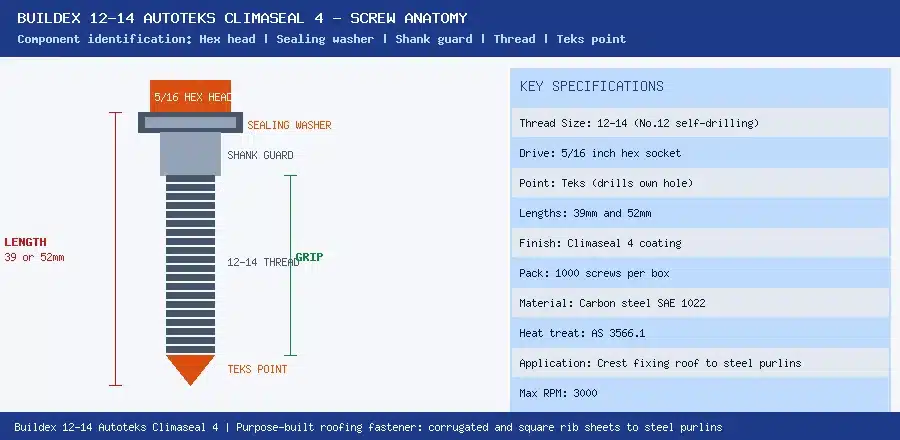
The 12-14 Autoteks Climaseal 4 is a purpose-built roofing screw available in two lengths — 39mm and 52mm — both supplied in packs of 1000. The ‘12-14’ designation refers to the No.12 thread diameter with 14 threads per inch, a standard in self-drilling steel fasteners. Key design features include a 5/16 inch hex drive for high-torque installation, a Teks self-drilling point that eliminates the need for pre-drilling, a sealing washer that creates a weather-tight seal at the roof penetration, and a Climaseal 4 coating for extended service life in corrosive environments.
The screw is manufactured from carbon steel SAE 1022 with heat treatment to AS 3566.1. A Colormatch finish option is available to blend with roofing sheet colours, useful for projects where the screw head is visible on the finished roof face.
Pullout Performance: The Numbers That Matter for Design
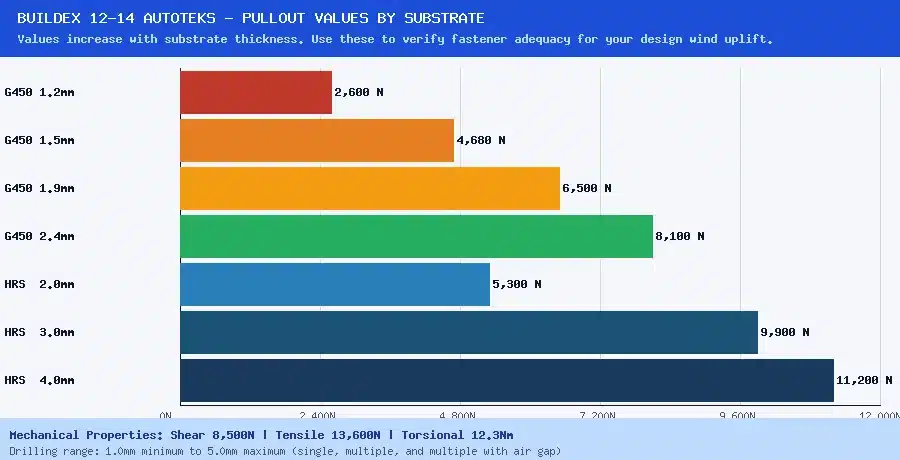
Pullout resistance is the most structurally critical performance metric for a roofing fastener. It determines how much force is required to pull the screw out of the steel purlin under wind uplift loading. The 12-14 Autoteks achieves the following pullout values across common purlin types and thicknesses:
- 2,600 N in Steel Purlin G450 — 1.2mm
- 4,680 N in Steel Purlin G450 — 1.5mm
- 6,500 N in Steel Purlin G450 — 1.9mm
- 8,100 N in Steel Purlin G450 — 2.4mm
- 5,300 N in Steel HRS — 2.0mm
- 9,900 N in Steel HRS — 3.0mm
- 11,200 N in Steel HRS — 4.0mm
The trend is clear and structurally logical: pullout resistance increases as substrate thickness and steel strength increase. For design purposes, these values must be compared against the calculated design wind uplift per fastener at the project location. In high-wind or cyclonic zones, this check is mandatory.
The mechanical properties of the fastener itself are equally relevant: single shear strength of 8,500 N, axial tensile strength of 13,600 N, and torsional strength of 12.3 Nm. These confirm the screw is not only a weatherproofing device but a structurally capable fastener designed to carry the loads imposed by roof sheets under real service conditions.
Corrosion Resistance: Why Climaseal 4 Matters
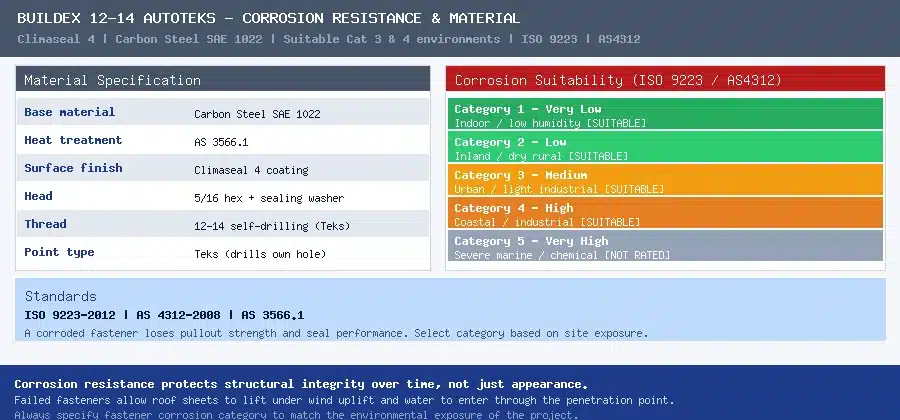
Corrosion is the primary cause of premature fastener failure in roofing. A corroded screw loses pullout strength, compromises the sealing washer, and in severe cases can allow the roof sheet to lift under wind load. The Climaseal 4 finish is rated for Category 3 (medium — urban and light industrial) and Category 4 (high — coastal and industrial) environments under ISO 9223-2012 and AS4312-2008.
For projects in Category 5 environments (severe coastal or marine), a higher-specification fastener finish is required. The practical implication for specifiers is straightforward: always confirm the corrosivity category of the project location before selecting fastener specification. A Category 4 fastener installed in a Category 5 environment will fail prematurely regardless of installation quality.
The material specification — carbon steel SAE 1022 with AS 3566.1 heat treatment — provides the base mechanical properties, while the Climaseal 4 coating provides the surface protection. Both are necessary: the heat treatment governs strength, and the coating governs durability.
Installation: Technique Is as Important as Specification
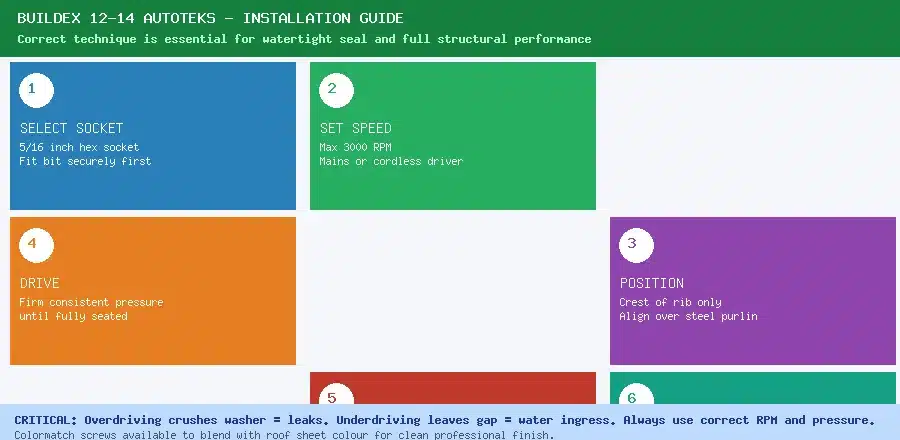
A correctly specified fastener installed with poor technique performs no better than a standard screw. The Buildex data sheet specifies the following installation requirements:
- Socket: 5/16 inch hex socket — fit the bit securely before starting
- Drive speed: Maximum 3000 RPM using a mains or cordless driver
- Pressure: Apply consistently firm pressure until the screw is fully seated
- Position: Crest of the rib only, aligned directly over the steel purlin below
The sealing washer is the most installation-sensitive component. Overdriving compresses the washer excessively, distorting its shape and creating gaps around the penetration point — a direct leak path. Underdriving leaves a visible gap between the washer underside and the roof sheet, also allowing water ingress. The correct result is a flat, fully compressed washer that contacts the roof sheet around its entire perimeter with no visible gaps and no distortion.
Controlling drive speed is central to achieving this. At excessive RPM, the screw seats faster than the operator can react, making overdriving almost inevitable. The 3000 RPM maximum gives the installer time to feel and stop at the correct seating torque.
Length Selection: 39mm vs 52mm
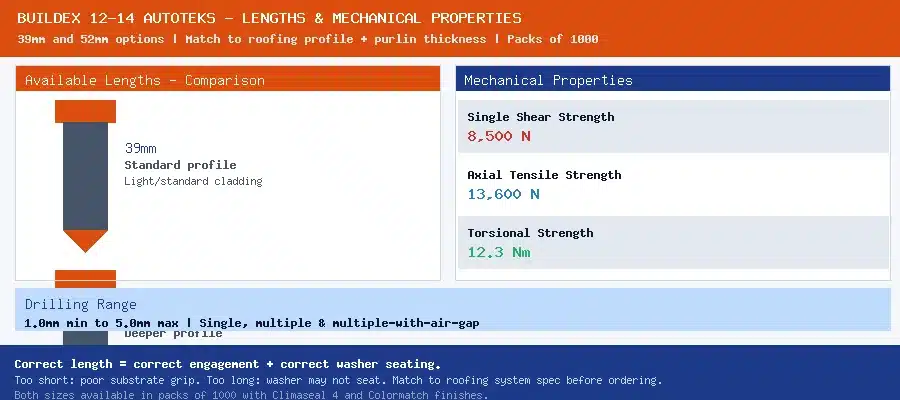
The two available lengths serve different installation scenarios. The 39mm option suits standard corrugated and square rib profiles where the cladding thickness and purlin engagement can be achieved within the shorter length. The 52mm option is appropriate for deeper roofing profiles, thicker cladding materials, or applications where a layer of insulation is present beneath the roof sheet.
The drilling range for both lengths is 1.0mm minimum to 5.0mm maximum of total material thickness — applicable to single thickness metal, multiple pieces of metal, and multiple pieces with an air gap between them. This versatility makes the product suitable across the range of common metal roofing configurations without requiring a separate product line for each application type.
Choosing the correct length is not optional. A screw that is too short may not achieve sufficient thread engagement in the purlin, reducing pullout resistance below the design value. A screw that is too long may not allow the washer to seat correctly against the roof sheet, compromising the seal. Always match the screw length to the specific roofing system before ordering.
The Sealing Washer: The Waterproofing Component
In a roofing fastener system, the sealing washer is the primary water exclusion device at the penetration point. The washer is pre-assembled under the hex head and is designed to compress against the roof sheet surface when the screw is driven to the correct torque, forming a continuous seal around the drill hole.
The washer’s performance depends entirely on correct installation: the right socket, the right RPM, and the right seating pressure. It is also why crest fixing is specified rather than pan fixing — placing the fastener at the crest of the rib keeps the penetration point away from water flow paths in the corrugation, reducing the risk of leak even if the washer seal is marginally imperfect.
Why Fastener Specification Matters in Roof Design
In most roof designs, the fastener is the smallest line item in the specification document. It is also the component most likely to be substituted on site if proper specification and procurement controls are not in place. A substituted fastener of lower corrosion category, incorrect length, or inadequate pullout rating can compromise a roof system that is otherwise well designed and well constructed.
The Buildex 12-14 Autoteks Climaseal 4 data sheet presents a fully documented fastener with published mechanical properties, pullout values across multiple substrates, corrosion ratings against Australian and international standards, and specific installation requirements. That level of documentation supports proper specification and gives designers and builders the data needed to verify fastener adequacy for the project conditions.
Final Thoughts
The Buildex 12-14 Autoteks Climaseal 4 is a well-documented, purpose-engineered roofing fastener. Its combination of self-drilling Teks point, sealing washer, Climaseal 4 corrosion protection, and published structural performance data makes it a strong choice for metal roofing projects where reliability and long-term durability are the priority.
The main lessons from the technical data sheet are straightforward: match the fastener length to the roofing system, select the corrosion category to match the site environment, install at the correct RPM with the correct socket and consistent pressure, and verify pullout values against design wind uplift. Get those four things right and the fastener will perform as intended across the full service life of the roof.
