
The most common cause of cracking in masonry is not the brickwork itself, but movement in the ground beneath the building. If the soil beneath the footings moves unevenly, the footings move with it, and the walls above crack. Understanding what drives that soil movement is the key to understanding why masonry cracks and how to prevent it from recurring.
Reactive vs Non-Reactive Soils
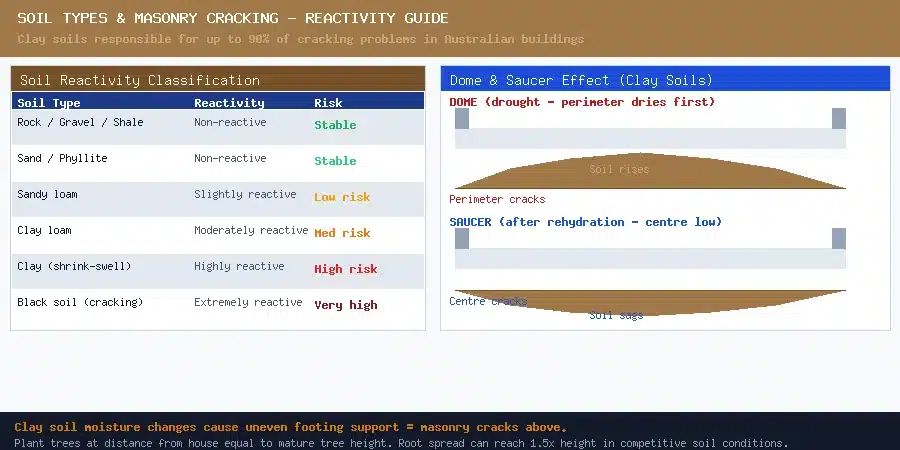
Foundations fall into two broad categories based on how they respond to moisture. Non-reactive soils such as rock, gravel, shale, phyllite, and sand do not change volume significantly as moisture varies, making them inherently stable bases for footings. Reactive soils, particularly clay-type and black soils, shrink when they dry and swell when wet. This volume change can be dramatic in highly reactive clays, and when it occurs unevenly beneath a building, the result is differential footing movement and masonry cracking above.
Changes in the water content of clay-type soils are responsible for up to 90% of cracking problems in Australian buildings. This figure underscores why soil type matters so much in residential construction, and why homes built on reactive clay without adequate soil management measures are significantly more vulnerable to cracking over time.
The Dome Effect and Saucer Effect
Two specific soil movement patterns are particularly common in clay-rich sites. In the dome effect, drought conditions cause the soil around the perimeter of a building to dry out faster than the soil beneath it. The perimeter shrinks and drops relative to the protected centre, creating a domed soil profile beneath the building. This produces perimeter cracking in the walls above as the edge of the building settles.
The saucer effect is roughly the reverse. After prolonged drought followed by significant rainfall, moisture can penetrate more quickly at the perimeter than beneath the building. The perimeter expands while the centre remains drier, creating a saucer-shaped soil profile. This reversal can cause cracking through the centre of the building rather than the edges, and can close some previously open perimeter cracks while opening new ones centrally.
Trees, Root Systems, and Soil Drying
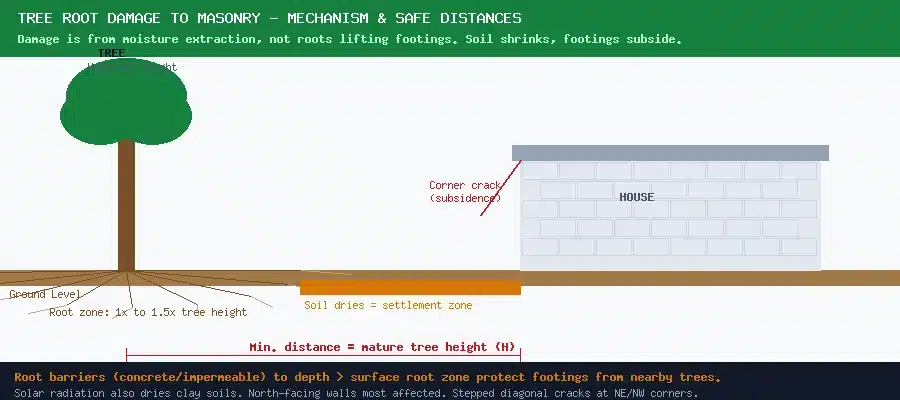
Trees are one of the most significant contributors to masonry cracking near Australian homes, but the mechanism is often misunderstood. The damage is almost never caused by roots physically lifting the footing. Instead, it results from tree drying settlement: roots extract large volumes of moisture from the soil, the soil shrinks, the footings subside, and cracks appear in the masonry above – typically as corner or stepped diagonal cracks near the closest corner of the building to the tree.
A tree root system may extend horizontally to a distance equal to its mature height, and in competitive soil conditions, up to 1.5 times its height. The practical guideline is straightforward: trees should generally be planted at a distance from the house equal to their expected mature height. Root barriers made from concrete or impermeable materials can be inserted between existing trees and vulnerable footings to a depth greater than the surface root system.
Solar radiation is another less obvious cause. Direct sun on bare clay soil on the northern face of a building can dry the soil sufficiently to cause foundation movement, even without trees present. Stepped diagonal cracks appearing near north-east and north-west corners are often a sign of this effect, particularly in homes where the northern garden bed soil is left exposed.
Final Thoughts
Masonry cracking nearly always starts below the surface, not in the wall. Clay soil moisture variation, tree moisture extraction, and solar drying are the three most common drivers. Understanding which mechanism is at work – by observing crack patterns, monitoring seasonally, and considering the site conditions – is the essential first step before any repair or remediation is attempted.
