
Building a strong, durable outdoor floor that connects cleanly to an existing structure is one of the more demanding tasks in residential and light commercial construction. The Stratco Pro-Beam® Exterior Flooring system addresses this challenge directly: it is a steel sub-floor framing solution designed for elevated decks, raised outdoor platforms, and exterior living areas, combining long-span structural capability with flexible connection options across timber, masonry, steel, and concrete substrates.
This guide breaks down the Pro-Beam® design documentation into a clear, practical resource for engineers and builders — covering the system components, attachment rules, footing requirements, connection details, and the load path logic that holds it all together.
What Is the Pro-Beam® System and How Does It Work?
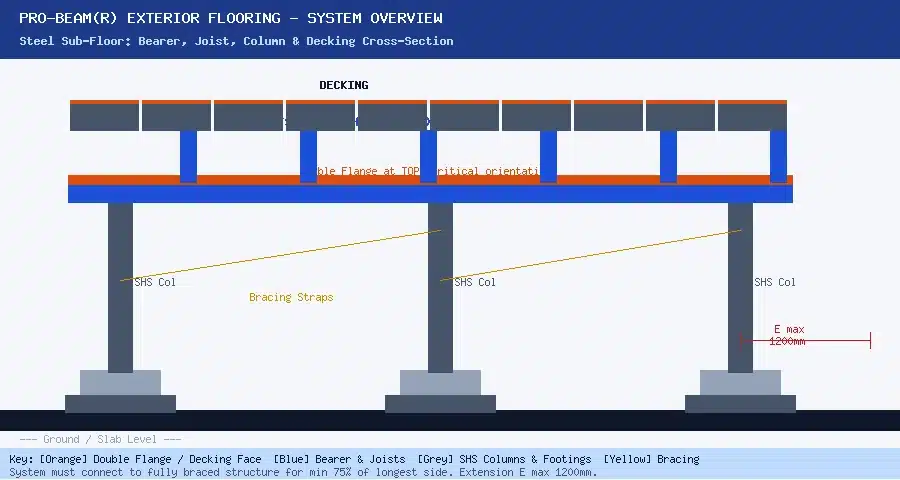
Pro-Beam® is a structural steel sub-floor system built around cold-formed steel bearer and joist members, SHS (Square Hollow Section) columns, beam joiners, aluminium spacers, and concrete footings. The system is designed so that a logical load path exists from the top of the deck all the way to the ground: decking loads transfer to joists, joists bear onto the main bearers, bearers are carried by SHS columns, and columns deliver all loads to concrete footings sized for the site conditions.
One critical installation detail runs through the entire system: all Pro-Beam joists and bearers must be installed with the double flange at the top. This is not a preference — it is a structural requirement. The double flange orientation affects the section’s bending capacity, the way it receives fixings, and the stability of the connection at each support point. Installing members in the wrong orientation will compromise performance and may not be visible until the structure is under load.
The system accommodates either screw-fixed or bolted connections depending on the substrate and application, which gives builders genuine flexibility across new build and retrofit projects without requiring specialist equipment or trades.
Attachment Rules: The Structural Logic Behind the System
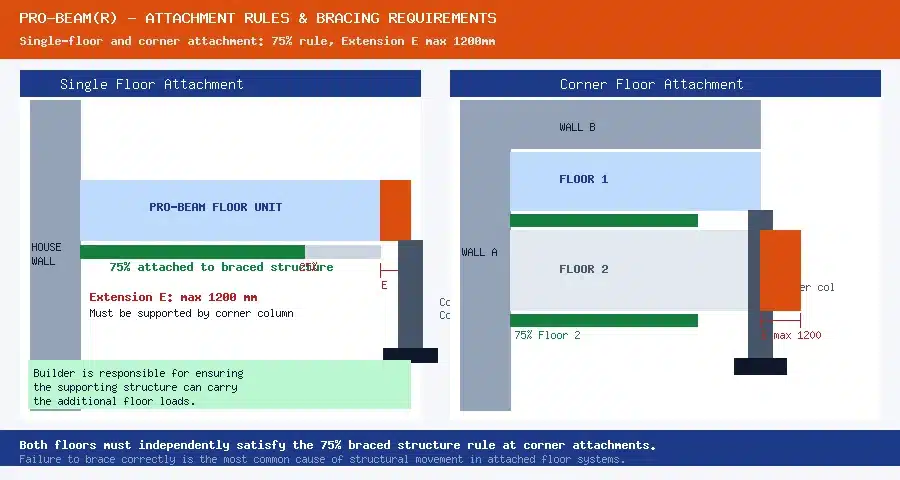
The attachment rules are the most important structural concept in the Pro-Beam® guide, and they are the most commonly misunderstood. The system is not designed to be freestanding in most applications — it depends on a properly braced host structure to resist lateral forces and transfer loads safely.
The rules are specific. For a single-floor attachment, the floor unit must connect to a fully braced structure for at least 75% of its longest side. For corner attachments — where two floors meet at a corner — both floors must independently satisfy this same 75% requirement. In both configurations, any extension beyond the braced attachment — denoted as dimension E in the guide — is limited to a maximum of 1200mm, and that extended section must be supported by a corner column.
The guide is explicit on one point that builders must not overlook: it is the builder’s responsibility to verify that the supporting structure can withstand the additional loads imposed by the floor system before installation begins. Connecting to an under-braced or structurally inadequate wall transfers the structural risk from the product to the installation decision.
Bracing and Footing Design
Lateral stability in the Pro-Beam® system is provided by steel bracing straps fixed to the joists. The size and spacing of bracing straps varies depending on the deck type and floor configuration — the span between brace points is governed by wall position and the overall frame layout. The principle is consistent: floor stability comes from a balanced, braced frame, not from the strength of individual members in isolation.
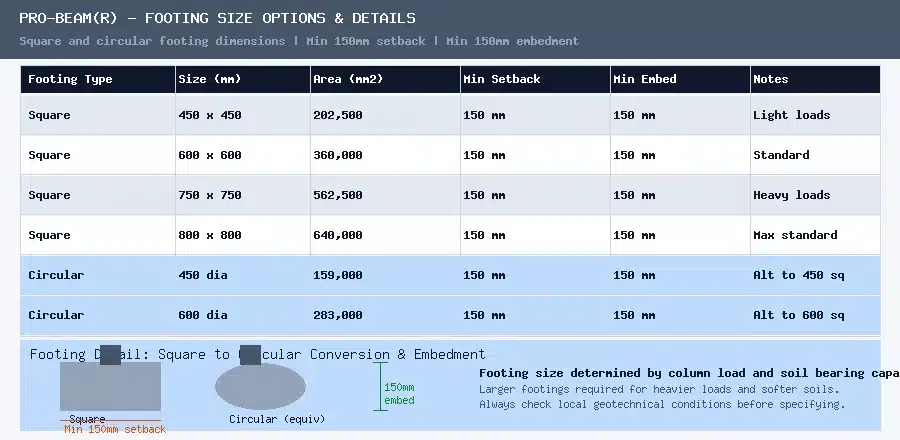
Footings are the base of the entire load path, and the guide provides a comprehensive table of options. Square footings range from 450mm × 450mm through to 800mm × 800mm, with circular equivalents available for each size. All footings require a minimum 150mm setback from the footing edge to the column base, and a minimum 150mm embedment depth for the column into or onto the footing. Footing size selection should reflect the column load intensity and the bearing capacity of the site soil — these values are not interchangeable across all sites, and local geotechnical conditions must be considered before specifying the smaller footing options.
Connection Details: Versatility Across Multiple Substrates
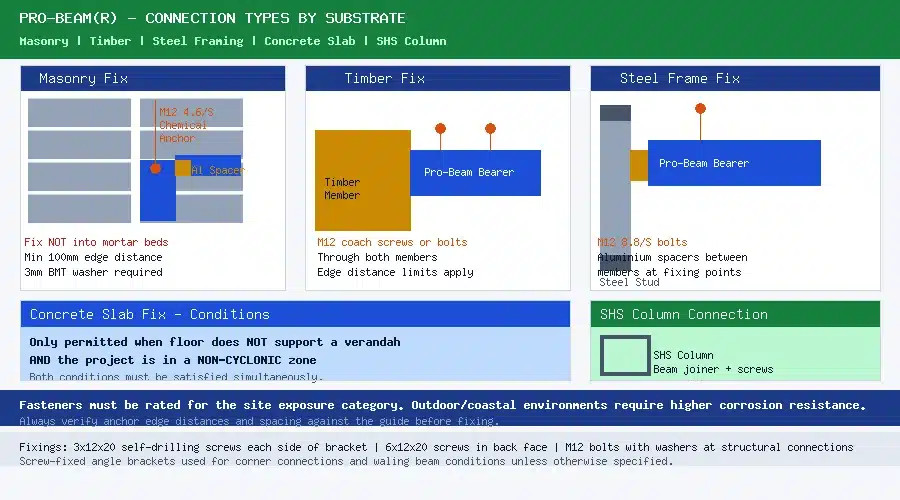
The connection section of the Pro-Beam® guide is where the system demonstrates its real-world versatility. Detailed fixing specifications are provided for five different substrate types, covering the vast majority of situations encountered in Australian residential and light commercial construction.
Masonry (blockwork and brick veneer): The standard fixing uses M12 4.6/S chemical anchors with Pro-Beam aluminium spacers and 3mm BMT washers. Anchors must never be placed into mortar beds — always into the masonry unit itself — and a minimum 100mm edge distance from the masonry face must be maintained. Chemical anchors provide far superior pull-out capacity in masonry compared to mechanical expansion anchors, which is why they are specified here.
Timber framing: M12 coach screws or bolts are used through both members, with edge distance limits and fixing spacing requirements as shown in the guide. This is a common condition in timber-framed homes where the floor attaches to the existing wall framing.
Steel framing: M12 8.8/S structural bolts are used with aluminium spacers positioned between members at each fixing point. The higher bolt grade (8.8/S versus the standard 4.6/S used in masonry) reflects the direct steel-to-steel load transfer at this connection.
Reinforced concrete slab: Slab fixing is conditionally permitted — only where the floor does not support a verandah, and only in non-cyclonic wind zones. Both conditions must be satisfied simultaneously. In any other configuration, a different attachment method must be used.
SHS columns and bearer-to-joist connections: Beam joiners connect bearers to SHS columns, with the specific fastener schedule called out in the guide as 3 × 12×20mm self-drilling screws each side of the bracket and 6 × 12×20mm screws into the back face. Screw-fixed angle bracket connections are specifically designated for corner connections and the waling beam condition.
The Load Path: From Deck to Ground
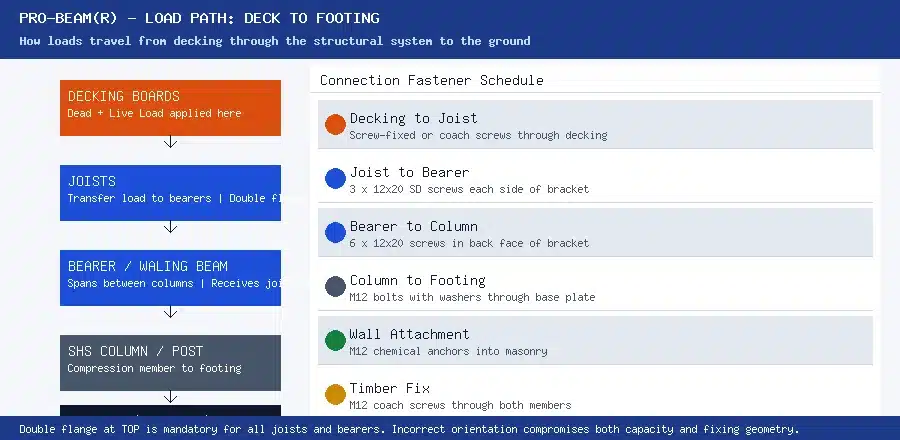
Understanding the Pro-Beam® load path is what makes the installation logic clear. Gravity loads — the weight of the deck itself, furniture, people, and any imposed loads — are applied at the top of the decking surface. Those loads transfer downward through the following sequence: decking transfers to joists via screws or coach bolts; joists transfer to bearers via the bracket and screw connection at each support; bearers transfer to SHS columns via the beam joiner; columns carry the loads in compression down to the footing; and the concrete footing distributes the column reaction to the soil below.
Lateral loads — wind, earthquake, or the horizontal component of uneven loads — are carried by the bracing straps within the floor frame and by the connection to the braced host structure at the wall attachment points. This is why the 75% attachment rule exists: without adequate connection to a braced structure, the floor system has no reliable load path for lateral forces, and the risk of racking, movement, or connection failure increases substantially.
Corrosion Protection and Fastener Selection
For any outdoor steel floor system, corrosion protection is not optional — it is a design decision that affects the structure’s service life. The Pro-Beam® guide specifically notes that fasteners must be suitable for the environmental exposure conditions of the project site. This means:
- Standard zinc-plated fasteners are suitable for sheltered interior environments only
- Hot-dip galvanised or stainless steel fasteners are required for exterior exposure
- Class 4 or stainless steel fasteners are required in coastal locations within approximately 1km of the ocean
- Aluminium spacers must be used where the Pro-Beam members contact dissimilar metals to prevent galvanic corrosion at the interface
Choosing the wrong fastener specification for the exposure environment is one of the most common and costly errors in outdoor steel construction. The fix after installation is invariably more expensive than getting it right at the specification stage.
Practical Advantages for Builders and Homeowners
Beyond the structural requirements, the Pro-Beam® system offers several practical construction advantages. Because the steel members have strong spanning capability, fewer intermediate supports are required compared to a timber sub-floor of equivalent size. This reduces installation time, lowers the number of footings needed, and creates more usable under-floor clearance — which matters for homeowners wanting storage space or clear access beneath a raised deck.
The system’s compatibility with screw-fixed or bolted connections makes it adaptable to different site conditions without requiring specialist equipment. The detailed connection drawings in the guide are clear enough that experienced DIY builders can follow them, while still providing the engineering rigour that professional installers and certifiers expect.
Final Thoughts
The Stratco Pro-Beam® Exterior Flooring system is built around a single clear idea: a steel sub-floor should be strong, adaptable, and correctly connected at every point in the load path. The attachment rules, footing tables, connection details, and bracing requirements in the guide all serve that purpose.
For structural engineers and experienced builders, the takeaway is straightforward: follow the load path from deck to footing, verify the host structure is adequately braced before attaching, select fasteners appropriate for the exposure environment, and install all members with the double flange at the top. Do those four things correctly and the Pro-Beam® system will deliver a durable, high-performing exterior floor structure that performs reliably over its full design life.
