When it comes to modern steel roofing and wall cladding, the choice of profile is not just an aesthetic decision — it is a structural one. Smartspan® is a square-corrugated steel sheet system designed to deliver long spans, reliable drainage, and architectural flexibility across residential, commercial, and industrial applications. This guide breaks down the Smartspan® Design Guide into a clear, practical resource for engineers, builders, and designers working with this system.
What is Smartspan® and Why It Matters
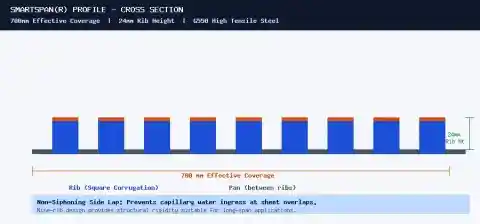
Smartspan® is a nine-rib square-corrugated steel roofing and walling profile manufactured from G550 high tensile steel. Its profile geometry is engineered to balance structural stiffness, water runoff efficiency, and visual appeal. The key geometric properties are 700mm effective coverage per sheet, 24mm rib height for rapid water shedding, and tight dimensional tolerances that support precision installation with consistent sheet-to-sheet alignment.
One of its most practically important features is the non-siphoning side lap. In poorly designed profiles, capillary action can draw water upward through the side lap joint, causing leakage even when the roof is correctly laid. Smartspan®’s side lap geometry is specifically shaped to break this capillary path and prevent ingress — a detail that matters enormously on low-pitch roofs where water moves slowly across the sheet surface.
Key Features and Design Advantages
The Smartspan® system offers three primary advantages that distinguish it from standard corrugated profiles. The first is its strength-to-span ratio: the G550 high tensile steel grade allows sheets to span greater distances between supports compared to standard G300 material, directly reducing the number of purlins or girts required and lowering overall structural cost. The second is drainage performance: the 24mm rib height provides a generous flow channel, and the non-siphoning side lap eliminates one of the most common causes of roof leaks. The third is design flexibility: sheets can be custom cut to length, installed at pitches as low as 2°, and used in both roofing and walling applications — making the system suitable for a wide range of building geometries and architectural styles.
Structural Performance: Spans, Wind Loads, and Standards
Structural performance is where the engineering detail matters most. The maximum recommended spans depend on sheet thickness, application type, and the number of fasteners per support. All span values in the Smartspan® Design Guide assume four fasteners per support.
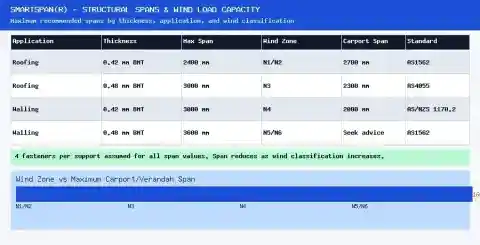
For carport and verandah applications, the allowable span reduces as wind classification increases. In N1/N2 wind zones, spans of up to 2700mm are achievable; by N4 this reduces to 2000mm. This relationship between wind zone and allowable span is not a conservative rule of thumb — it is derived from Australian Standards AS1562, AS4055, and AS/NZS 1170.2, which govern design for serviceability (deflection control) and strength (failure resistance) limit states.
For projects in higher wind classifications (N5, N6, or cyclonic C categories), span tables alone are insufficient. Structural engineering advice specific to the project should be sought before specifying Smartspan® in these environments.
Roof Pitch, Thermal Expansion, and Spring Curving
The minimum roof pitch for Smartspan® is 2° (a 1:30 slope). Below this threshold, drainage cannot be reliably maintained and the risk of ponding — and the accelerated corrosion that follows — increases significantly. Even at the minimum pitch, roof run length must be carefully controlled for the expected rainfall intensity of the project location.
Thermal expansion is a design consideration that is easy to overlook but important to manage correctly. Steel sheets expand and contract with temperature change, and the effect is more pronounced with darker colours, which absorb more solar radiation. The guide specifies: light colours allow up to 24m sheet length before an expansion joint is required; dark colours require a joint at 16m. Ignoring this will result in distortion, fastener pull-out, and potential roofing failure over time.
For architectural applications, Smartspan® can be spring curved to create curved roof forms. The minimum radius is 20m and the maximum is 60m, with purlin spacing limited to 1200mm (for 0.42 BMT sheets) or 1400mm (for 0.48 BMT sheets). This capability opens the system to modern curved roof designs without requiring specialist curved-profile manufacturing.
Water Drainage and Maximum Roof Run
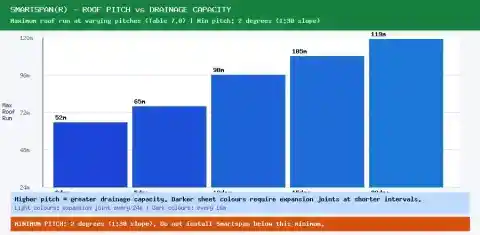
The relationship between roof pitch and maximum drainage capacity (roof run) is one of the most practically important design parameters for any low-pitch roof. The Smartspan® Design Guide Table 7.0 provides maximum roof run values for different pitches and rainfall intensities. At the minimum 2° pitch under low rainfall intensity, the maximum roof run is approximately 52m. At 10° this increases to 90m, and at 22° to 119m.
For large industrial sheds and warehouse buildings, where long roof runs are common, this table is a critical design check. Exceeding the maximum roof run for the design rainfall intensity will result in gutter overflow and potential building damage. Always cross-reference the site rainfall intensity from the relevant BOM data before finalising roof geometry.
Installation: Fastening, Sheet Direction, and End Treatment
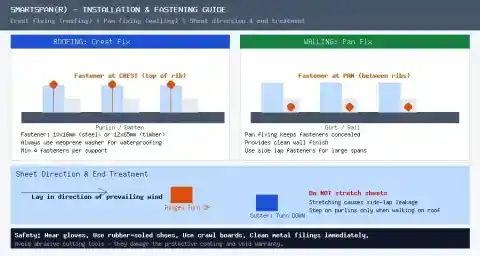
Correct installation method is what separates a watertight Smartspan® roof from one that will leak within its first year of service. The fastening method is application-specific: roofing uses crest fixing (fastener placed at the top of the rib), while walling uses pan fixing (fastener placed in the flat pan between ribs). Using the wrong fixing method — for example, pan fixing on a roof — creates leak points at every fastener penetration.
All fasteners must be used with neoprene washers to create a watertight seal at the penetration point. Typical fastener sizes are 10×16mm for fixing to steel purlins and 12×65mm for fixing to timber. Where large spans are involved, side lap fasteners are required to prevent sheet lifting and separation under wind uplift.
Sheet direction and end treatment are both important for weatherproofing performance. Lay sheets in the direction of the prevailing wind so that overlaps face away from the dominant wind-driven rain. At the ridge end, the corrugation is turned upward; at the gutter end, it is turned downward into the gutter. Do not stretch sheets during installation — stretching distorts the side lap profile and creates a path for water ingress that cannot be corrected without replacing the sheet.
Corrosion, Material Compatibility, and Long-Term Durability
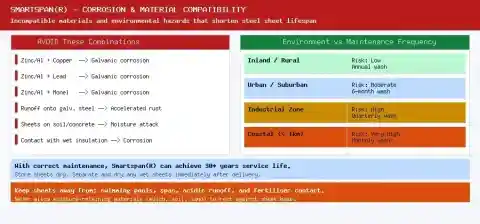
Corrosion is the primary cause of premature failure in steel sheet roofing and cladding systems, and it is almost always avoidable with correct specification and installation practice. The Smartspan® guide identifies several material compatibility issues that must be managed carefully.
Zinc/aluminium coated steel (the base coating for Smartspan®) is galvanically incompatible with copper, lead, and Monel. Where these materials are present — in flashings, fasteners, or adjacent roof elements — they must be separated from the steel sheets using compatible materials or physical barriers. Runoff from copper or lead components must not be allowed to flow across Smartspan® surfaces.
Environmental exposure also significantly affects service life. Coastal locations within 1km of the ocean, industrial zones with atmospheric pollutants, and areas with swimming pools or spas nearby all represent elevated corrosion environments. In these locations, the maintenance frequency must be increased accordingly — and in very aggressive environments, a higher specification coating (such as Colorbond® Ultra or equivalent) should be considered at the design stage rather than retrofitted later.
Handling, Safety, and Storage
Steel sheet handling causes more installation defects than most builders expect. Wearing gloves is important not just for personal safety but to prevent finger-contact corrosion marks on the sheet surface. Abrasive cutting tools (such as angle grinders with cutting discs) must not be used on Smartspan® sheets — the heat and sparks generated damage the protective coating along the cut edge, creating an immediate corrosion risk. Use tin snips or a nibbler instead, and immediately clean any metal filings off the sheet surface before they rust onto the coating.
When walking on installed sheets, step on purlins only — stepping in the pan between purlins can cause permanent deformation. Use rubber-soled shoes and crawl boards for maintenance access on larger roofs. During storage, keep sheets dry and separated; wet sheets stacked together will develop ‘wet storage stain’ (white rust) that permanently marks the coating surface.
Ongoing Maintenance for Maximum Service Life
With appropriate maintenance, Smartspan® can achieve a service life of 30 years or more in typical inland environments. The maintenance requirement is straightforward: regular washing with clean water to remove dust, salt, and atmospheric pollutants that would otherwise progressively attack the coating. In harsh environments — coastal, industrial, or pool-adjacent — this washing frequency increases from annual to quarterly or even monthly. Never allow moisture-retaining materials such as soil, mulch, or sand to rest against the base of sheets, as sustained moisture contact is the single most effective accelerant of base-edge corrosion.
Final Thoughts
The Smartspan® system is a genuinely well-engineered steel roofing and cladding solution — but it performs to its design potential only when specified, installed, and maintained correctly. The design guide covers span tables, wind loads, drainage capacity, fastening methods, material compatibility, and maintenance requirements in detail, and every one of those topics deserves attention before work begins.
The underlying principle applies regardless of which roofing system you are working with: correct design, correct installation, and consistent maintenance together determine how long a building envelope lasts. With Smartspan®, the engineering support is there — the outcome depends on how carefully that guidance is followed on site.
Be the first to comment.