
Installing a Stratco Outback® Flat Attached patio, verandah, or carport is one of the most rewarding home improvement projects you can undertake — but it demands careful planning, sound structural judgment, and meticulous attention to detail at every stage. This guide walks you through the complete installation process, from the first planning decisions to final weatherproofing and ongoing maintenance.
Before you begin: Always check local government and council requirements, confirm your existing structure can handle the additional loads, and read all instructions thoroughly before any work commences.
Planning Before the First Hole Is Dug
Good patio construction starts long before any posts, beams, or roof sheets are installed. Lay out all major components on the ground, check them against the delivery note, and mark the overall footprint of the verandah or carport area.
- Checking column spacing and beam positions against your approved plans
- Confirming the layout is square by comparing diagonal measurements
- Identifying drainage paths and ensuring adequate fall is achievable
- Verifying that door and window openings remain clear where beam-to-wall connections are required
- Digging post holes to specified dimensions before any framework begins
The tools typically needed include a drill with hex-head adaptor, rivet gun, tape measure, tin snips, spirit level, hacksaw, post hole digger, silicone gun, spanners or ratchet, adjustable construction props, concrete, and a ladder. Structural fixings for attaching the unit to an existing structure, and anchors for column installation, are not supplied and must be sourced separately.
Understanding the System: How the Components Work Together
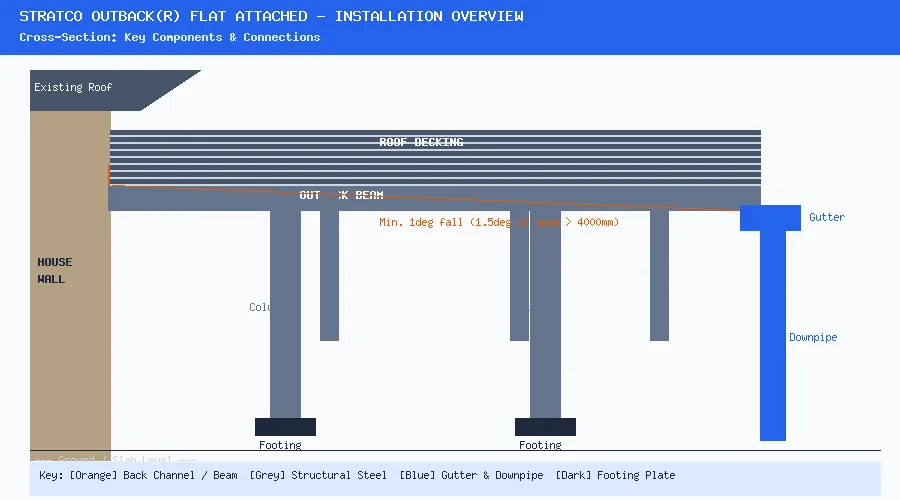
Before installation begins, it helps to understand the Stratco Outback® as a connected structural system. Key components and their roles include the back channel (which creates the weatherproof junction between new roof and existing structure), Outback beams (the primary structural frame), columns (carrying roof loads to the ground or slab), post caps and beam end caps (protecting exposed ends from moisture), gutter and downpipes (managing stormwater runoff), optional Rooflite panels (providing natural daylighting), and footing plates (transferring column loads to slab or ground anchors).
Back Channel Installation: The Weatherproof Starting Point
The back channel is arguably the most critical element in an attached installation. It forms the watertight junction between the new patio roof and the existing building envelope. The short edge of the back channel faces downward, and the channel must extend past the beam end to allow overflow into the gutter. Where multiple channel lengths are required, butt them together and seal all joints with silicone.
The attachment method varies by substrate: timber fascia uses timber screws into pre-drilled holes; steel fascia uses self-drilling screws; and brickwork or masonry requires appropriately rated masonry anchors. For steel-framed houses, additional reinforcement measures are required, including fascia strengthening brackets, reinforcing RHS members, and tie-down braces. These are structural requirements, not optional enhancements.
Wall Attachment, Suspension Brackets, and Beam Support
Separate instructions apply for different wall conditions. For wall-mounted attachment, wall brackets are positioned where beams meet the wall, drilled and anchored into the masonry or framing, and the beam is slid into position and fastened securely. Where beams are suspended from the fascia, suspension brackets are used instead, positioned under and over the back channel and sealed with silicone to the rear to prevent water ingress.
Erecting the Framework
Once the back channel and support brackets are secure, the main framework can be erected. Install the end fascia beam first, ensuring the double thickness is on top. Use adjustable construction props to hold it at the correct fall: a minimum of 1 degree, or 1.5 degrees where spans exceed 4000 mm. Prepare and install the front fascia beam, fitting post brackets and beam brackets, then add beam fillers.
Where beams are joined over a column, use an in-line beam connector. Where joins occur away from a post, a full moment beam connection is required. Install intermediate beams and purlins progressively, checking the frame for squareness by comparing diagonal measurements at each stage. Recheck all roof and gutter falls before proceeding to decking.
Columns and Footings: Transferring the Load Safely
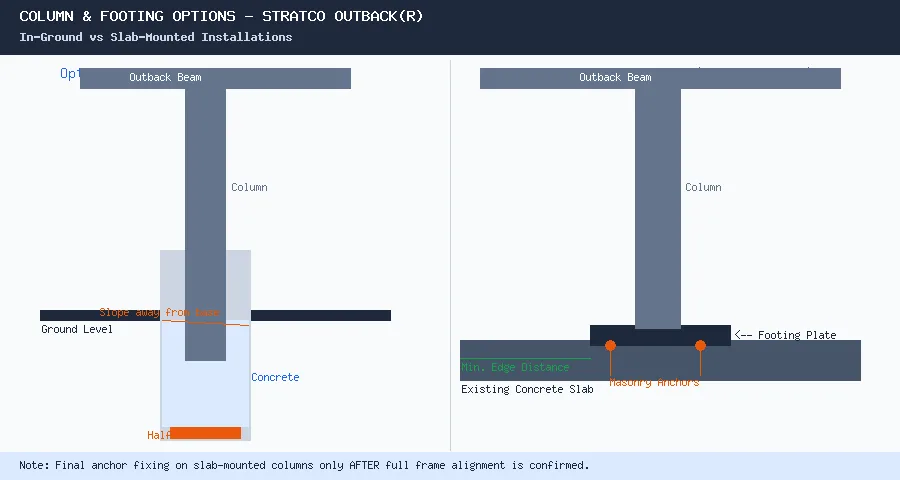
Columns are the load path from roof to ground, and the footing detail must be appropriate for the site conditions. For in-ground installation, dig holes to the required dimensions, place a half brick at the base for bearing, set columns to correct height and plumb, then concrete in place once alignment is confirmed. The finished concrete surface must slope away from the column base to prevent water ponding.
For slab-mounted columns, footing plates are fixed using masonry anchors or screwbolts at minimum specified edge distances. Final anchor fixing is carried out only after column alignment is confirmed. For all column types, keep the base clear of pooled water and persistent soil contact — this is a corrosion prevention requirement, not a cosmetic preference.
Roofing Decking Installation and Weather Protection
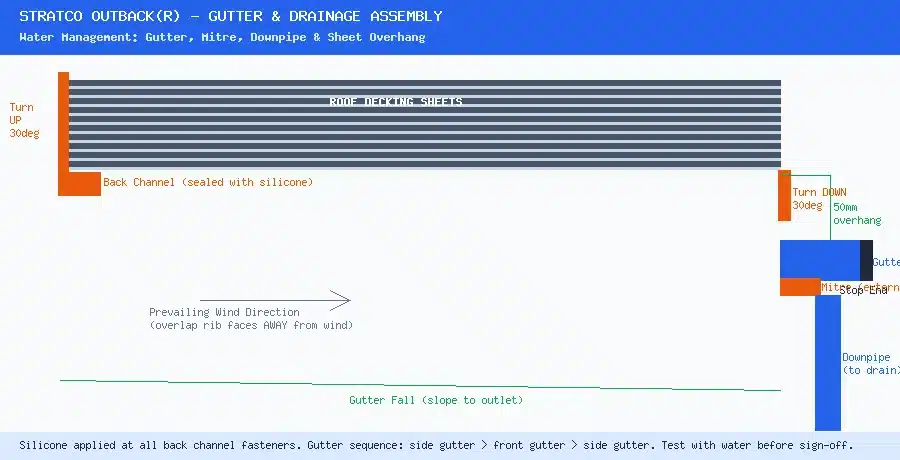
Before laying sheets, the ends must be turned to improve weatherproofing: the rear end (at the back channel) is turned up approximately 30 degrees, and the front end (at the gutter) is turned down approximately 30 degrees. Sheets are laid with a 50 mm overhang into the gutter, with the overlapping rib facing away from the prevailing wind. Mark beam lines at regular intervals to keep sheets square during installation.
At the back channel, rivets are used through the raised edge with silicone applied over fasteners. At supporting beams, self-drilling screws are used at specified centres, with increased fixing frequency required in cyclonic regions.
Optional Rooflite Panels for Natural Light
The Outback Rooflite panels allow diffused natural light into the structure. Panels must overlap the adjacent steel deck correctly and align with the deck profile. Pre-drill holes slightly oversize to allow for thermal expansion and contraction, and fasten with self-drilling screws and domed washers. Use the specified infill arrangement to finish exposed ends neatly.
Gutter Assembly and Drainage
Water management is a primary design consideration for any flat-roof structure. Calculate gutter lengths and cut to size, install stop ends and mark mitre positions, cut and fit mitre brackets, then position downpipe outlets. Install the first side gutter, front gutter, and final side gutter in sequence, riveting and siliconing all fixings. Attach downpipes to column brackets and connect to outlets. The installation guide includes printed templates for external and internal gutter mitres, including 135-degree variations, reflecting the precision required for leak-free fabrication.
Final Checks and Finishing
Before considering the project complete: confirm all posts are plumb in both directions, verify concrete footings slope away from column bases, complete final anchor fixings on slab-mounted columns, fit all post caps and beam end caps, inspect all silicone joints and touch up any gaps, and test gutter fall and downpipe flow with water.
Ongoing Maintenance: Protecting Your Investment
A Stratco Outback® structure will perform well for decades with appropriate maintenance. Wash regularly with clean water to remove dust, salts, and atmospheric pollutants — especially important in coastal environments. Never place dirt or paving sand against column bases. Avoid close proximity to swimming pools or spas without appropriate protective coatings. Inspect silicone seals annually and re-seal as required, particularly at the back channel junction.
Final Thoughts
The Stratco Outback® Flat Attached system is a well-engineered outdoor roofing solution — but its performance depends entirely on the quality of installation. A patio or carport is not just roof sheets on posts. It is a load-bearing structure that must be anchored to an existing building, sealed against weather, drained efficiently, and maintained regularly to perform as designed. Precision at installation creates reliability for years to come.
