When building an attached verandah, patio, or carport, one of the most structurally critical details is how the new roof connects back to the existing house. Get this connection wrong and no amount of quality roofing or careful decking will compensate. The Stratco Outback® Riser Bracket is engineered specifically for this junction — fixing through the fascia and anchoring directly to the house rafter to create a strong, reliable support point for the entire attached roof system.
Used in combination with an extension channel, the riser bracket transfers connection forces along the rafter line more effectively, distributing loads across the existing roof framing rather than concentrating them at a single point. The result is a more robust and structurally sound attachment than a standard fascia fixing alone can provide.
This is not a casual DIY step. The builder is responsible for checking dimensions, levels, bolting locations, and the adequacy of the existing house roof structure before any cutting or fixing begins.
Stratco Outback® Riser Bracket Installation Guide
The guide is explicit: people erecting the structure should already have building experience, because modifications to the house structure may be required. The bracket is one part of a broader structural upgrade — not a standalone fix.
Why the Riser Bracket Matters Structurally
The primary function of the riser bracket is to create a secure, load-transferring connection between the new patio roof and the house rafter through the fascia. The number and location of rafters to be strengthened depends on the project layout, but rafter spacing must not exceed 1200 mm. This spacing requirement is not arbitrary — it ensures loads are distributed across multiple support points rather than relying on a single connection that could overstress the existing structure.
One of the most practically useful features of the system is its roof-pitch flexibility:
- The 22° Riser Bracket is designed for roof pitches from 20° to 25°
- The 27° Riser Bracket covers roof pitches from 25° to 30°
This range makes the system adaptable to a wide variety of house roof geometries — particularly valuable when matching a new attached structure to an existing building with a non-standard pitch.
Installation Starts with Accurate Marking and Preparation
Like all structural connections, the riser bracket installation is only as good as the preparation that precedes it. The fascia must be carefully marked and a rectangular hole notched so the bracket can pass cleanly through the front of the fascia. Rushed or inaccurate cutting at this stage creates alignment problems that compound through the rest of the installation.
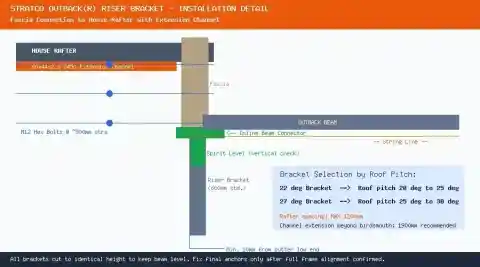
The guide prescribes a specific sequence: install the extreme end brackets first, so the internal brackets can be aligned correctly against both the external vertical and horizontal faces. All brackets should be positioned as close to the gutter as possible, with a recommended minimum clearance of 10 mm from the lowest end of the gutter.
A critical installation requirement: the external face of the bracket must remain vertical to the ground, even where the roof rafter and bracket meet at slightly different angles. Structural adequacy is the priority — appearance follows from correct alignment, not the other way around.
The Extension Channel: Creating a Longer, More Uniform Load Path
One of the most important details in the system is the use of a 60 × 44 × 2.0 G450 galvanised extension channel. This channel sits with its bottom end at the eave end of the house rafter, with its pre-drilled holes matched to the corresponding holes in the riser bracket. Additional holes are then drilled at approximately 500 mm centres to complete the connection along the rafter.
The effect of this arrangement is a longer and more uniform load path along the existing roof framing, reducing stress concentrations at the bracket-to-rafter interface. The guide also specifies:
- Recommended channel extension beyond the birdsmouth: 1900 mm
- Recommended web overhang: 400 mm
These dimensions define how far the reinforcement arrangement extends along the rafter, ensuring the connection engages sufficient rafter length to distribute the imposed loads safely.
Bracket Height, Cutting, and Keeping the Beam Level
The riser bracket has a standard height of 600 mm, but this may need to be reduced depending on the total height required for the verandah. The critical point: all brackets must be cut to the same dimension. If bracket heights vary, the beam mounted into the top of the brackets will not be level, and the entire finished roofline will reflect that error.
This is a simple instruction, but one that is easy to overlook on site. Measure and cut all brackets together before installation begins, not individually as you go.
Setting and Fixing the Brackets Correctly
The installation sequence for achieving correct alignment is straightforward but must be followed in order:
- Clamp the riser bracket to the rafter and check the external face is vertical using a spirit level
- Run a string line along the bottom face of the end brackets to establish a reference line for the internal brackets
- Insert internal brackets into the fascia holes and clamp them into position against the string line
- Once alignment is confirmed across all brackets, fix through all bracket and extension channel holes using M12 hex head bolts
- Attach 65 mm inline beam connectors to the top of the tube section of each riser bracket using two 12 × 20 mm self-drilling screws
The inline beam connectors at step 5 are how the riser bracket integrates into the wider Outback framing system. The bracket does not operate in isolation — it is a designed interface between the existing house structure and the new Outback beam layout.
What the Installation Diagrams Show
The Stratco installation diagrams are worth studying carefully, not just skimming. The key figures show:
- Figure 3: The bracket, inline beam connector, string line, and spirit level working together during setup — illustrating the alignment process as a system, not a series of independent checks
- Figure 4: The relationship between the rafter, gutter, stud wall, and the 10 mm minimum clearance near the gutter, plus the recommended extension and overhang dimensions along the rafter
These diagrams reinforce the core principle of the installation: every dimension and clearance specified exists for a structural or waterproofing reason.
Maintenance After Installation
The guide closes with a maintenance reminder that applies equally to the riser bracket system and the broader Outback structure. For a steel connection system, ongoing maintenance is what protects the structural investment after the build is complete:
- Wash regularly with clean water to remove dust, salt, and atmospheric pollutants — particularly important in coastal or industrial environments
- Do not place water-retaining materials against columns or structural bases
- Avoid close proximity to swimming pools, spas, and other chlorine or salt-rich environments without appropriate protective coatings
- Inspect fixing points and silicone seals annually; re-seal or re-tighten as required
Final Thoughts
The Stratco Outback® Riser Bracket is a small component with a significant structural role. It bridges the gap between a new attached patio roof and the existing house framing in a way that is aligned, reinforced, and adaptable to different roof pitches. Used correctly with the extension channel and inline beam connectors, it creates a load path that is both structurally sound and durable.
The guide makes the priority clear from the outset: the strength of the finished structure depends on careful marking, proper reinforcement of the existing roof framing, accurate fixing sequence, and ongoing maintenance. No individual component — however well designed — can compensate for shortcuts in any of those areas.
Be the first to comment.