
A retaining wall that looks good on the day it is built but fails within a few years is not a successful retaining wall. The Versawall® system by Adbri Masonry is designed to avoid that outcome. It is a pure vertical concrete segmental retaining wall built around interlocking blocks, a logical drainage system, and a structured installation sequence that puts the right materials in the right places from the ground up. This guide covers everything you need to know before you build with Versawall® — from base preparation and drainage through to corners, capping, and ongoing maintenance.
What Is Versawall® and What Can It Be Used For?
Versawall® is a concrete segmental retaining wall system manufactured by Adbri Masonry, designed for garden beds, planter boxes, feature walls, and retaining sloped land. Its pure vertical profile makes it space-efficient compared to battered systems that step back from the face as they rise — a significant advantage in narrow residential sites where every centimetre of flat ground counts.
The system is suitable for:
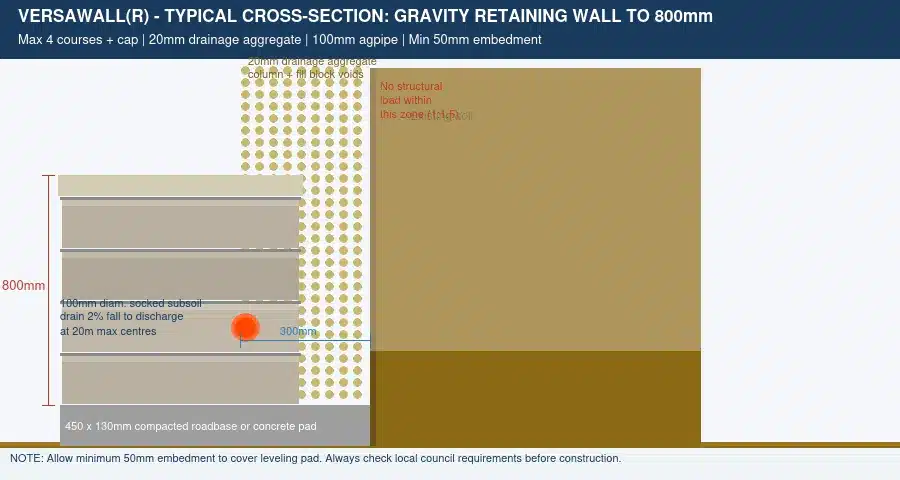
- Unreinforced gravity retaining walls up to 800mm high (4 courses plus capping unit) — no engineering required in most council areas
- Planter boxes and raised garden beds up to 800mm
- Engineered retaining walls up to 1400mm using No Fines Concrete backfill, with council and engineer approval
- Curved walls — Versawall® can achieve gentle curves for landscaped garden design
Understanding the Block System
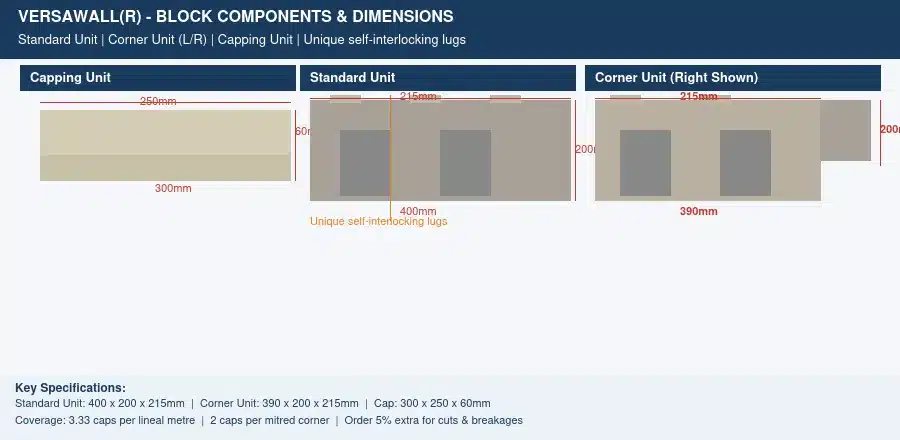
The Versawall® system comprises three block types that work together. The standard unit (400 × 200 × 215mm) forms the body of the wall and features unique self-interlocking lugs on the top face and tongue-and-groove joints on the sides — these keep each course aligned without mortar. The corner unit (390 × 200 × 215mm, available in left and right configurations) handles external corners neatly, eliminating the awkward cutting that other systems require. The capping unit (300 × 250 × 60mm) finishes the wall with a clean, flat top surface fixed in place with landscape-grade adhesive.
One quantitative detail worth knowing before ordering: Versawall® requires 3.33 capping units per lineal metre of wall, and 2 caps per mitred corner. The guide recommends ordering 5% extra to account for cuts and breakages.
The Base: The Most Important Part of Any Retaining Wall
The Versawall® guide is emphatic on this point: if you start level, you can finish level. A wall that begins on an uneven base will carry that error through every subsequent course. Invest time in the base and choose the option that best suits your skill level and site conditions.
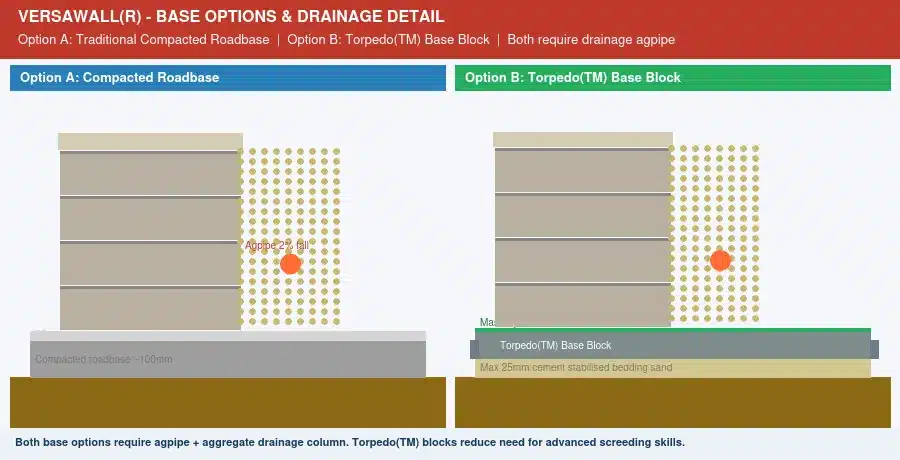
Option A — Traditional Compacted Roadbase: Roadbase is compacted in the trench to approximately 100mm depth, then a 25mm sand-and-cement screed is applied over it to create a level starting surface. This is the more common method for unreinforced gravity walls but requires screeding skill to execute accurately.
Option B — Torpedo™ Base Block: The Torpedo™ Base Block sits in the trench on a maximum 25mm layer of cement-stabilised bedding sand, which has enough ‘give’ to allow the blocks to be tapped level with a rubber mallet. Once the Torpedo™ pad is level, the first course of Versawall® blocks is simply glued down to the centre of the Torpedo™ using landscape-grade adhesive. This system significantly reduces the screeding skill required and is well suited to DIY builders.
Drainage: Non-Negotiable for Every Wall
Water pressure building up behind a retaining wall is one of the primary causes of wall failure. For Versawall®, drainage is achieved through two simultaneous measures that must both be present:
- Block core infill: Every core in every block on every course must be filled with free-draining aggregate (such as 20mm blue metal). This aggregate adds mass to the wall — which is what allows it to reach 800mm unreinforced — and provides a drainage path through the wall itself
- Drainage column + agpipe: A 300mm wide column of free-draining aggregate must be placed behind the wall at every course. A 100mm diameter socked subsoil drainage pipe (agpipe) is then installed at the base of this column, set at a 2% fall, with outlets at maximum 20m centres to carry water away from the wall
A wall that looks structurally sound but lacks proper drainage will eventually fail when water pressure builds up behind it. There are no shortcuts on this step.
Step-by-Step Installation
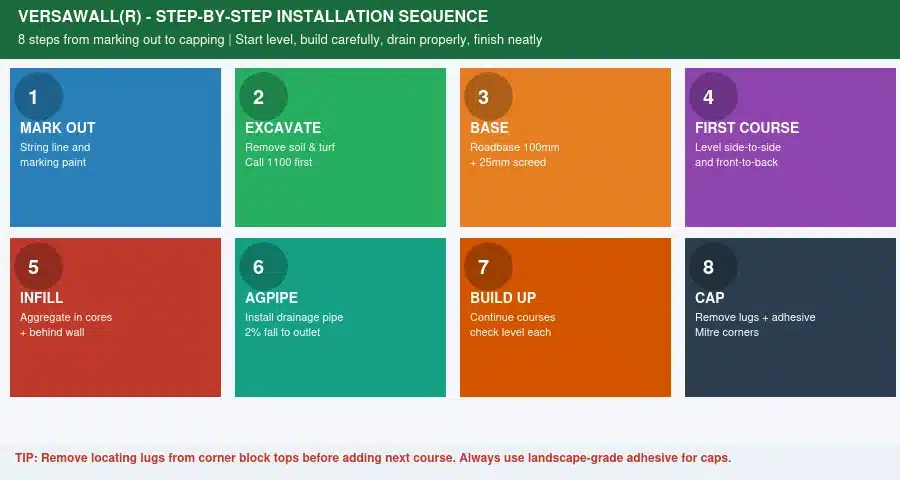
Before any excavation begins, call Dial Before You Dig on 1100 to identify underground services. With that confirmed, the installation sequence follows eight logical steps.
Step 1 — Mark out: Use marking paint and string line to define the wall alignment. Step 2 — Excavate: Remove soil and turf along the marked line. Step 3 — Prepare footing: Install compacted roadbase and screed, or lay Torpedo™ Base Blocks, to create a level pad. Step 4 — First course: Begin at the lowest point or most visible section; place blocks and check for level side-to-side and front-to-back. Step 5 — Infill and backfill: Fill cores with blue metal and backfill 300mm behind the wall with the same aggregate. Step 6 — Agpipe: Install the drainage pipe at the base of the aggregate column with correct fall. Step 7 — Subsequent courses: Continue building, brushing debris from block tops and checking level at every course. Step 8 — Cap: Remove locating lugs from the top course with a mallet and bolster, apply landscape-grade adhesive, and press capping units firmly into place.
Building Internal and External Corners
Corners are where many retaining wall projects become complicated, but the Versawall® system provides dedicated solutions for both conditions.
Internal corners use standard Versawall® units set at half-bond and 90 degrees, with the locating lugs removed from the tops of the corner blocks. Cores and the 300mm zone behind each course are filled with blue metal and compacted.
External corners use the dedicated left and right corner units. Before adding the next course, remove the two lugs from the top of each corner unit. To finish neatly, mitre-cut the capping units using a brick saw (wet saw), remove all locating lugs from the top course, and secure the caps with landscape-grade adhesive. Two caps are required per mitred corner.
Height Limits, Engineering, and Council Approval
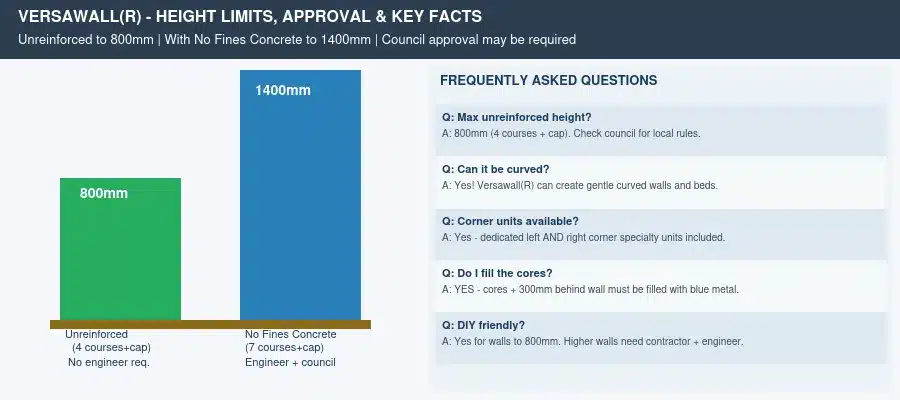
The height limits for Versawall® are clearly defined but must be interpreted alongside local council requirements, which vary by location. As a general guide: walls up to 800mm (4 courses plus cap) can typically be built without engineering or reinforcement in most council areas — but always confirm your local maximum before starting work. Walls to 1400mm require No Fines Concrete (NFC) backfill, engineer-approved plans, and council certification.
High clay content soils or sites with poor drainage also warrant engineering advice regardless of wall height. The 800mm unreinforced limit assumes reasonable soil conditions; clay soils generate higher lateral pressure and may require a lower unreinforced limit or specialist design.
Curved Walls, Garden Beds, and Planting Tips
Versawall® can be used to create gentle curves in retaining walls and garden beds — an advantage over many competing systems that work only in straight lines. For curved applications, take care with block alignment and use a string line on a stake at the curve centre to maintain consistency.
For garden beds and veggie patches, the Adbri guide offers a practical planting tip: rather than filling the entire bed with soil first and then digging individual plant holes, bring in a base layer of soil to approximately two-thirds of the wall height, place the plants in position (unpotted), then top up with the remaining soil or mulch until it sits just below the bottom of the capping unit. This approach saves significant effort and protects the fresh wall from wheelbarrow impacts during the soil-filling stage.
Maintenance and Long-Term Performance
Concrete segmental retaining walls require very little maintenance compared to timber alternatives. Versawall® blocks will not rot, are not vulnerable to termites, and are designed specifically for external exposure. Occasional washing with a hose, pressure cleaner, or stiff brush with soapy water will remove surface dirt and biological growth.
Some concrete products develop efflorescence — a chalky white residue caused by salts migrating to the surface. This is a natural occurrence that typically fades over time with weathering. If faster removal is required, specific efflorescence cleaning products are available from masonry suppliers. It is not a structural defect and does not affect wall performance.
Final Thoughts
The Versawall® system is well thought through: the block geometry, the drainage requirements, the base options, and the corner details all work together as a complete solution rather than a collection of separate products. The system is genuinely DIY-friendly for walls up to 800mm when the instructions are followed carefully, and scales to engineered heights of 1400mm for projects that require more.
The guide’s core message is worth repeating: start level, drain properly, infill every core, and finish neatly. Do those four things and Versawall® will deliver a clean, durable retaining wall that performs well across its full design life.
