
The seismic base shear is the single most critical output of any earthquake design process — it is the total lateral force that the structure must be proportioned to resist at its base. Under the Building Code of Pakistan Seismic Provisions 2007 (BCP SP-2007), the static force procedure of Section 5.30.2 governs the design of the majority of structures in Pakistan, and it requires the engineer to evaluate four separate equations and apply the most critical result. Understanding how those four equations interact, and what each parameter physically represents, is the foundation of competent seismic design under this code.
The Four Governing Equations
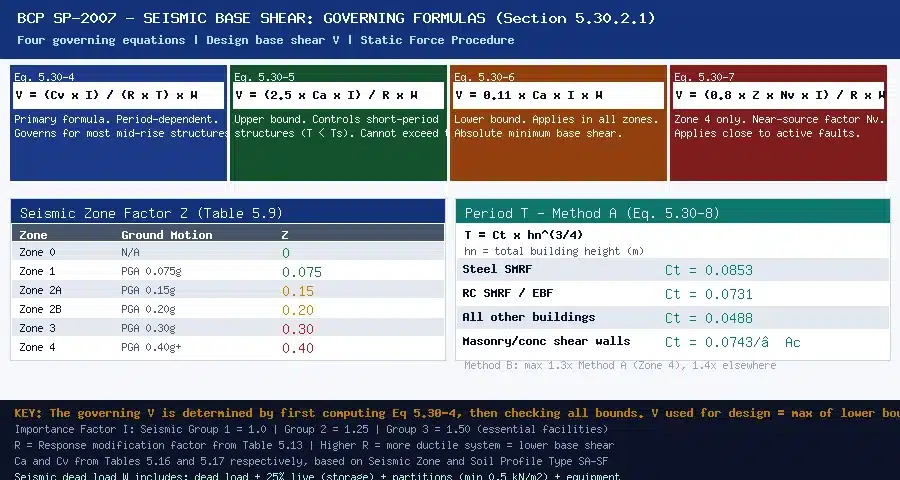
Section 5.30.2.1 of BCP SP-2007 defines the design base shear V through a hierarchy of four equations. The primary formula is:
V = (Cᵥ × I) / (R × T) × W [Equation 5.30-4]
This is the period-dependent formula and governs for most mid-rise structures in the velocity-controlled region of the response spectrum. Here, Cᵥ is the seismic coefficient from Table 5.17 that represents the velocity-related ground motion, I is the occupancy importance factor, R is the response modification factor, T is the fundamental period of the structure, and W is the seismic dead load. The 1/T dependency reflects the physical reality that longer-period structures attract less acceleration but more displacement.
Three additional equations apply as bounds. The upper bound is:
V = (2.5 Cₐ I) / R × W [Equation 5.30-5]
This governs in the acceleration-controlled region of the spectrum, for short-period structures where T is less than the transition period Tₛ. No structure can have a base shear lower than this value, regardless of how long its period is computed to be.
The first lower bound is:
V = 0.11 Cₐ I W [Equation 5.30-6]
This absolute minimum applies in all seismic zones and prevents excessively low design forces from being used regardless of how long the computed period is. For Seismic Zone 4 only, a second lower bound applies:
V = (0.8 Z Nᵥ I) / R × W [Equation 5.30-7]
This equation captures near-source effects through the near-source factor Nᵥ, which amplifies ground motion for sites close to active faults. In practice, the design base shear V is the value that satisfies all four conditions simultaneously: it must equal or exceed both lower bounds, and must not exceed the upper bound. For most structures in Zones 3 and 4, Equation 5.30-5 or 5.30-6 governs over 5.30-4 at short periods, while 5.30-4 governs at intermediate periods.
Seismic Dead Load W and the Importance Factor I
The seismic dead load W is not simply the building dead load. Section 5.30.1.1 specifies that W includes: all dead load; a minimum of 25% of floor live load in storage and warehouse occupancies; a partition load of not less than 0.50 kN/m² where partitions are included in the floor design; design snow loads exceeding 1.50 kN/m² at a maximum 75% reduction; and the total weight of all permanent equipment. These additions mean that W for a storage building or a heavily serviced industrial facility will be substantially larger than the structural dead load alone, and the base shear grows proportionally.
The importance factor I (Table 5.10) scales the entire design force up for structures whose failure would have disproportionate consequences. Ordinary structures use I = 1.0. Structures in Occupancy Category 2 (schools, hospitals, emergency response facilities) use I = 1.25. Essential facilities such as hospitals that must remain operational post-earthquake, emergency vehicle garages, and emergency communication centres use I = 1.50. The effect is direct: a hospital in Seismic Zone 3 must be designed for 50% more base shear than an equivalent ordinary office building at the same site.
Computing the Fundamental Period T
Section 5.30.2.2 provides two methods for determining T. Method A is an empirical approximation based solely on building height:
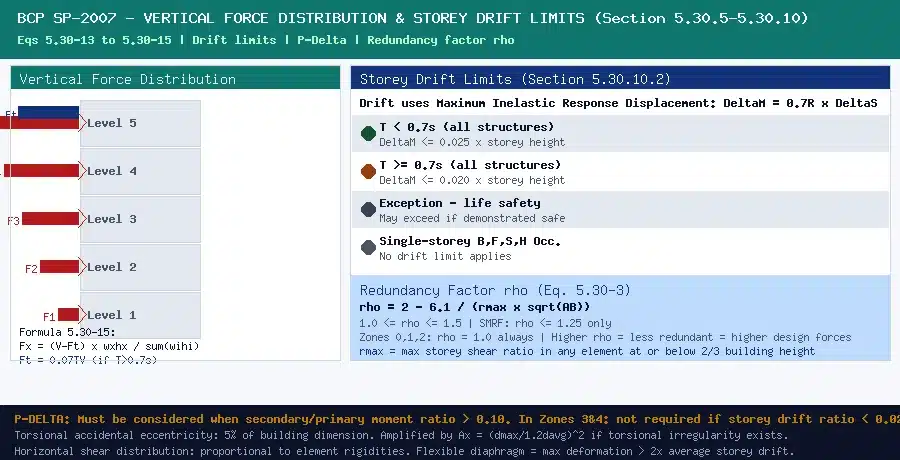
T = Cₜ (hₙ)^(3/4) [Equation 5.30-8]
where hₙ is the total height of the main portion of the structure above the base in metres, and Cₜ depends on the structural system: 0.0853 for steel SMRFs, 0.0731 for reinforced concrete SMRFs and eccentrically braced frames, and 0.0488 for all other buildings including shear wall systems. For buildings with concrete or masonry shear walls, an alternative Cₜ = 0.0743/√Aₙ may be used, where Aₙ is the combined effective area of shear walls in the first storey accounting for their aspect ratios.
Method B allows a more refined period from a structural analysis, computed using Equation 5.30-10 with the Rayleigh method or from eigenvalue analysis. However, BCP SP-2007 places a cap: the Method B period cannot exceed 1.3 times the Method A period in Seismic Zone 4, or 1.4 times in Zones 1, 2 and 3. This cap prevents engineers from using overly flexible analytical models to artificially inflate the computed period and reduce the required base shear.
The Response Modification Factor R and the Seismic Coefficients Ca and Cv
The response modification factor R is the single most consequential engineering decision in the base shear calculation. R accounts for the expected ductility, redundancy, and overstrength of the lateral-force-resisting system — it allows the design forces to be reduced below elastic demand in recognition that ductile systems can dissipate energy and deform inelastically without collapse. R values from Table 5.13 range from 2.2 for cantilevered column systems to 8.5 for Special Moment Resisting Frames and dual systems. A change from an ordinary shear wall (R = 4.5) to a special moment frame (R = 8.5) nearly halves the required base shear, but mandates substantially more demanding detailing requirements under Chapters 7 and 8.
The seismic coefficient Cₐ (Table 5.16) is an acceleration-related coefficient that increases with both the seismic zone factor Z and the soil amplification associated with softer soil types. Similarly, Cᵥ (Table 5.17) is the velocity-related coefficient. Both coefficients are amplified for soft soils (Type Sᴄ, Sᴇ) relative to rock (Type Sₐ), reflecting the well-documented soil amplification effect. A structure on soft clay (Sᴇ) in Zone 3 will have both Cₐ and Cᵥ significantly higher than an identical structure on rock at the same site.
Vertical Distribution, Storey Forces, and the Redundancy Factor
Once the design base shear V is established, it must be distributed over the height of the structure using Equations 5.30-13 to 5.30-15. A concentrated force Fₜ = 0.07TV is first applied at the top to account for higher-mode effects; this term is non-zero only when T exceeds 0.7 seconds and is capped at 0.25V. The remaining shear is distributed to each level in proportion to the product of the weight at that level and its height above the base. This inverted triangular distribution, with the largest forces at the top, correctly approximates first-mode response for regular structures.
Before finalising the design forces, the engineer must calculate the Redundancy/Reliability Factor ρ from Equation 5.30-3: ρ = 2 − 6.1/(rₘₐˣ√Aв). The factor ρ ranges between 1.0 and 1.5 and is applied as a multiplier to the horizontal earthquake load Eₕ. Structures with high element-storey shear ratios rₘₐˣ — meaning a small number of elements carry most of the lateral load — attract a higher ρ and therefore higher design forces. For Special Moment Resisting Frames, ρ is capped at 1.25 to incentivise multiple bays of frame action.
Storey Drift Limits and P-Delta Effects
Section 5.30.10 limits storey drift to 2.5% of the storey height for structures with T < 0.7 seconds, and 2.0% for T ≥ 0.7 seconds. These limits are based on the Maximum Inelastic Response Displacement ΔM = 0.7RΔS, not the elastic displacement under design forces. Multiplying by 0.7R — which for a SMRF with R = 8.5 gives a factor of 5.95 — dramatically amplifies the elastic displacements before checking them against the drift limit. This makes drift often the controlling design criterion for moment frames in high seismic zones.
P-delta effects must be considered when the secondary-to-primary moment ratio exceeds 0.10. In Seismic Zones 3 and 4, P-delta need not be checked when the storey drift ratio does not exceed 0.02/R. For a SMRF with R = 8.5, this threshold is a storey drift ratio of 0.00235 — effectively requiring P-delta consideration in most real-world applications with that system.
Final Thoughts
The BCP SP-2007 static base shear procedure is a disciplined multi-step calculation: select the structural system and R, establish the seismic dead load W, compute the period T by the appropriate method, evaluate all four governing equations, distribute the resulting force over the building height, and check drift. Each step interacts with the others, and simplification at any stage — underestimating W, inflating T beyond the code cap, or selecting an over-optimistic R without satisfying the detailing requirements — produces a structurally unsafe outcome. For structures in Zones 3 and 4, where Pakistan’s seismic risk is highest, each of these parameters deserves careful, code-compliant treatment.
