Durability is the most consequential design decision in masonry construction — and the one most frequently under-specified. A masonry wall that is structurally adequate but incorrectly specified for its corrosive environment will begin deteriorating within years: mortar joints erode, wall ties corrode, and the structural system that holds cavity walls together quietly fails behind the face. Australian Standard AS 3700–2011 Masonry Structures addresses this through Section 5, a systematic framework for selecting masonry units, mortar, built-in components, and reinforcement protection based on the exposure environment of the project.
This article works through the AS 3700–2011 durability provisions in the sequence a structural engineer would apply them: determining the exposure environment, identifying the location of each element, selecting materials from Table 5.1, and verifying reinforcement protection. It is written for practising engineers, but is also relevant to building designers, certifiers, and contractors who need to understand why specific materials are required on a given project.
Why Durability Matters in Masonry Design
Masonry is often perceived as inherently durable, and in benign conditions it is. But the performance of a masonry wall system depends on the coordinated durability of every element within it: the units, the mortar, the wall ties, the lintels, the shelf angles, the reinforcement, and the grout. If any one of these components is under-specified for the environment, the system as a whole is compromised — often in ways that are invisible until significant deterioration has occurred.
The 2011 edition of AS 3700 restructured the durability requirements significantly compared to the 2001 edition. Key changes included a restructured durability table, mandatory screw fixing of face-fixed masonry veneer ties in some locations, and improved guidance on control joint spacing — all of which affect how Section 5 is applied in practice.
Step 1: Determine the Exposure Environment (Clause 5.3)
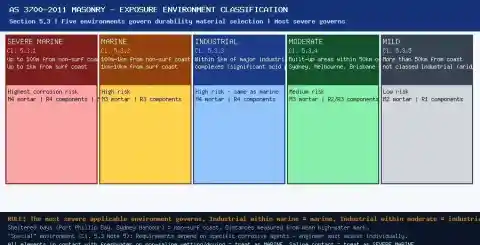
AS 3700–2011 Clause 5.3 defines five exposure environments in order of severity. Critically, where more than one environment classification could apply, the most severe governs. The standard works through the environments in order from most to least severe, so the first applicable classification is the one that applies.
- Severe Marine (Cl. 5.3.1): Areas up to 100m from a non-surf coast and up to 1km from a surf coast, measured from the mean high-water mark. This is the most demanding environment outside the special category, and requires M4 mortar, Exposure-grade units, and R4 (stainless steel) components.
- Marine (Cl. 5.3.2): Areas from 100m to 1km from a non-surf coast and from 1km to 10km from a surf coast. Sheltered bays including Port Phillip Bay and Sydney Harbour are explicitly classified as non-surf coast.
- Industrial (Cl. 5.3.3): Within 1km of major industrial complexes producing significant acidic pollution. AS 3700 notes there are only a few such regions in Australia, citing Port Pirie as an example. Industrial environments within marine zones are classified as marine, not industrial.
- Moderate (Cl. 5.3.4): Built-up areas within 50km of the coast, including the suburban areas of Melbourne, Adelaide, Hobart, and many parts of Sydney, Perth, and Brisbane. Most Australian city construction falls into this category.
- Mild (Cl. 5.3.5): More than 50km from the coast and not industrial. Subdivided into mild-arid, mild-temperate, and mild-tropical based on Figure 5.1 of the standard, with different climatic implications for each subzone.
Two important clarifications from the notes to Clause 5.3 are frequently overlooked in practice. First, any external element in contact with freshwater or subject to non-saline wetting and drying must be treated as marine regardless of its distance from the coast. Second, any element subject to saline wetting and drying must be treated as severe marine. These rules apply even in inland locations where salt contamination exists in groundwater or irrigation water.
Step 2: Identify the Location of Each Element (Clause 5.4)
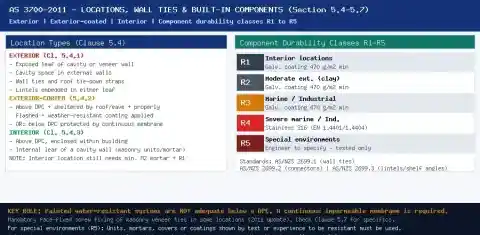
Once the exposure environment is established, the next step is to classify each element of the masonry system by its location. Clause 5.4 defines three locations, and the distinction between them has significant implications for material selection.
Exterior (Cl. 5.4.1) is the most demanding location and applies to: the exposed leaf of any external cavity wall or masonry veneer; the cavity space itself; wall ties and roof tie-down straps in those walls; and lintels embedded in either leaf of an external cavity wall. The last two points are particularly important — even the internal leaf’s lintels are classified as exterior because they are embedded in a wall system that is exposed.
Exterior-coated (Cl. 5.4.2) allows reduced durability requirements where an element in an exterior location satisfies all of the following: it is above a DPC, sheltered by a roof, eave or coping, all junctions are properly flashed, and a weather-resistant coating is applied in accordance with Clause 4.7.4. Alternatively, elements below a DPC that are protected by a continuous impermeable membrane (not a painted system) may also qualify as exterior-coated. The distinction between a genuine impermeable membrane and a painted water-resistant system is specifically called out in the standard — painted systems are not adequate for below-DPC protection.
Interior (Cl. 5.4.3) applies to elements above a DPC that are enclosed within the building. Importantly, the masonry units and mortar forming the internal leaf of a cavity wall are classified as interior, even though the wall ties connecting the two leaves are classified as exterior. This distinction drives different material specifications for different elements in the same wall assembly.
Step 3 and 4: Select Units and Mortar (Table 5.1)
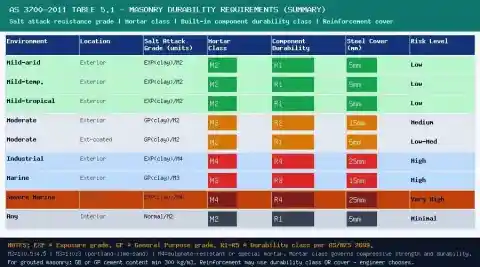
Table 5.1 is the central reference in Section 5. For each combination of exposure environment and location, it specifies four minimum requirements: the salt attack resistance grade of masonry units, the mortar class, the durability class of built-in components, and the reinforcement cover. Masonry designed in accordance with this table is deemed to satisfy the performance requirements of Clause 2.3.1, so no further durability analysis is required.
The salt attack resistance grade of masonry units is graded as Normal, General Purpose, or Exposure under AS/NZS 4455.1. Normal-grade units are suitable only for interior or mild-arid exterior locations. General Purpose units cover moderate environments. Exposure grade is required for marine, severe marine, and industrial environments.
Mortar class under AS 3700 runs from M2 (weakest, interior use) through M3 to M4 (strongest, required for severe exposure). As a practical guide, M2 mortar is broadly equivalent to a 1:1:6 cement:lime:sand mix by volume. M3 eliminates lime and uses a stronger 1:0:3 cement:sand ratio. M4 requires sulfate-resistant cement or specialist masonry cement and is reserved for aggressive environments including industrial zones, severe marine, and soils with sulfate contamination.
Step 5: Select Built-In Components (Clause 5.7)
Built-in components — including wall ties, masonry anchors, shelf angles, connectors, lintel bars, bed joint mesh, bolts, and fixings — must have at least the durability class given in Table 5.1. The durability class scale runs from R1 (minimum, for interior use) to R5 (special environments, requiring individual engineering assessment).
- R1: Interior and mild exterior locations. Galvanised coating minimum 470 g/m².
- R2: Required for clay units in moderate exterior locations. Galvanised coating minimum 470 g/m².
- R3: Marine and industrial environments, general purpose designation. Galvanised coating minimum 470 g/m².
- R4: Severe marine and severe industrial environments. Stainless steel Grade 316 (EN 10088-1/1.4401 or 1.4404) is the deemed-to-satisfy specification for R4 components.
- R5: Special environments. No generic specification — components must be tested or have demonstrated satisfactory service history in comparable conditions.
The compliance references are AS/NZS 2699.1 for wall ties, AS/NZS 2699.2 for connectors and accessories, and AS/NZS 2699.3 for lintels and shelf angles. For situations not covered in Table 5.1, components must either have a demonstrated service history in similar conditions or be tested under an appropriate regime.
The 2011 update introduced mandatory screw fixing of face-fixed masonry veneer ties in some locations. This addressed a long-standing performance issue with nail-fixed ties in higher-exposure environments, where corrosion of the nail left the tie effectively unfixed while the face remained visually intact.
Step 6: Specify Reinforcement Protection (Clause 5.9)
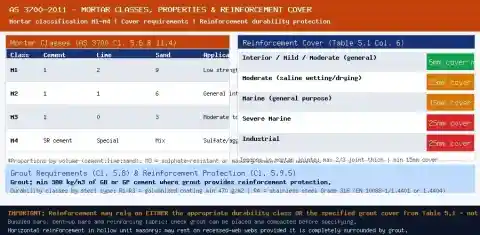
For reinforced and prestressed masonry, Section 5.9 requires that reinforcement and tendons have protection at least equivalent to the durability class specified in Table 5.1. Importantly, the engineer can choose between two protection strategies: specifying the appropriate durability class for the reinforcement itself, or providing the required grout cover from Table 5.1 Column 6.
Where grout cover is used as the protection mechanism, the grout must contain a minimum 300 kg/m³ of GB or GP cement. This ensures both adequate compressive strength and low permeability in the grout. The specified covers range from 5mm for interior and mild environments up to 25mm for severe marine and industrial exposures.
For reinforcement embedded in mortar joints, the maximum overall diameter or thickness is limited to two-thirds of the design joint thickness, and a minimum 15mm cover to any exposed surface of the mortar joint is required regardless of environment.
The durability classes for reinforcement steel are deemed to be satisfied as follows: for R1 to R3, galvanised steel with a coating mass of at least 470 g/m²; for R4, stainless steel Grade 316 (EN 10088-1/1.4401 or 1.4404, the same grade commonly specified for wall ties).
The Design Process in Practice
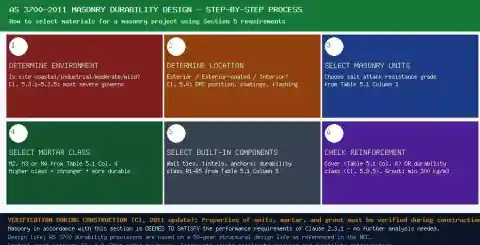
Applying AS 3700–2011 Section 5 in practice follows a clear sequence. The exposure environment is determined first, using the most severe applicable classification. The location of each element is then identified — bearing in mind that different elements in the same wall assembly (units, mortar, ties, lintels) may have different location classifications. Table 5.1 is then consulted for each combination of environment and location to determine the minimum required grade for each material.
Two practical points deserve emphasis. First, the most common error in durability design is misclassifying the exposure environment — particularly in coastal suburban areas that fall into the moderate category but whose specific site conditions (e.g., high-exposure ridge sites, salt-laden prevailing winds, proximity to saline groundwater) may warrant a more conservative classification. The deemed-to-satisfy provisions of Table 5.1 are based on typical conditions; unusual site conditions require engineering judgment.
Second, the durability of the mortar joint specifically is strongly influenced by workmanship. AS 3700 requires that in marine, severe marine, and special environments, joints be tooled to give a dense, water-shedding finish (Clause 4.9.2). A correctly specified M3 or M4 mortar that is poorly tooled or shrinks away from the units will perform significantly below its specified durability. This is one area where construction quality verification during the works is directly linked to achieving the design durability outcome.
Control Joints and Long-Term Durability
The 2011 edition of AS 3700 added explicit guidance on control joint spacing (Clause 4.9) as a direct response to observed cracking failures in service. Control joints that are absent, incorrectly spaced, or improperly filled allow moisture ingress that accelerates corrosion of embedded components. In exposure-critical environments, the sealant in control joints is effectively a maintained component of the durability system — it requires periodic inspection and replacement in the same way that joint sealants in curtain wall systems do.
For long-term durability, the maintenance responsibilities of the building owner are also relevant. While AS 3700 is a design standard rather than a maintenance standard, the durability provisions implicitly assume that the wall will be maintained — that coatings are renewed, sealants are replaced, weepholes are kept clear, and flashings remain functional. A masonry wall that is correctly specified but poorly maintained over decades will not achieve its design durability life.
Final Thoughts
AS 3700–2011 Section 5 provides a structured, deemed-to-satisfy framework for masonry durability design that is both practical and comprehensive. The exposure environment classification, location definitions, and Table 5.1 material requirements work together to ensure that every element in a masonry wall system — from the face units to the hidden ties in the cavity — is specified at the appropriate durability level for its service conditions.
For structural engineers working on masonry projects across Australia, the key discipline is rigour in environment and location classification. The deemed-to-satisfy provisions of Table 5.1 are powerful tools precisely because they eliminate the need for case-by-case durability analysis — but only when the inputs (environment and location) are correctly identified. Underspecifying those inputs to reduce material cost is a risk that compounds over the design life of the structure.
Be the first to comment.