Foundation design in Pakistan sits at the intersection of geotechnical uncertainty, seismic risk, and structural demand — three factors that are each individually demanding, and that interact with each other in ways that reward careful engineering. The Building Code of Pakistan Seismic Provisions 2007 (BCP SP-2007) provides the primary regulatory framework for foundation design in seismic areas, supplemented by ACI 318 for concrete design, ACI 336 for raft foundations, and ASTM D1586 for site investigation. This article works through the complete foundation design process for Pakistan: site classification, foundation type selection, bearing capacity calculation, structural design of each foundation type, seismic requirements, and load combinations — all referenced to the applicable code clauses.
Codes and References Governing Foundation Design in Pakistan
Before beginning any foundation design, the engineer must assemble the applicable code references:
- BCP SP-2007 (Building Code of Pakistan – Seismic Provisions 2007): Primary seismic design standard. Chapters 3 (Site Considerations), 4 (Soils and Foundations), 5 Division IV (Earthquake Design). Based on UBC 1997.
- ACI 318-19: Building Code Requirements for Structural Concrete. Governs all reinforced concrete foundation elements — footings, grade beams, pile caps, raft slabs.
- ACI 336.2R: Guide for the Design and Construction of Concrete Slabs on Ground — relevant for raft and mat foundations.
- ASTM D1586: Standard method for SPT (Standard Penetration Test) — the most common site investigation method in Pakistan.
- ASTM D2487: Unified Soil Classification System — for soil classification from laboratory testing.
- Terzaghi and Meyerhof theories: The standard bearing capacity equations referenced in Pakistani practice, with Terzaghi’s general bearing capacity equation for continuous/square/circular footings and Meyerhof’s extended formula for eccentric and inclined loading.
Step 1: Site Investigation and Soil Profile Classification (BCP SP-2007 Chapter 4)
No foundation can be designed without a geotechnical investigation. BCP SP-2007 Section 4.3.1 requires that each site be assigned a soil profile type based on properly substantiated soil engineering characteristics. The classification uses one of three methods: the shear wave velocity method (vₛ over top 30m), the SPT N-value method (average N over top 30m), or the undrained shear strength method (average sᵤ for cohesive layers). In Pakistani practice, the SPT-N method using Equation 4.4-2 is dominant:
N̄ = Σdᵢ / Σ(dᵢ/Nᵢ) [BCP Equation 4.4-2]
where dᵢ is the thickness of each soil layer (m) and Nᵢ is the SPT N-value of that layer. This harmonic mean gives more weight to weaker layers, which is conservative and appropriate for seismic design.
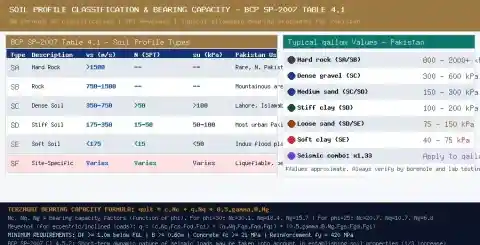
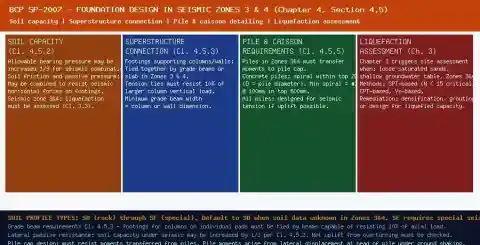
The six soil profile types and their implications for design are summarised above. For Pakistani engineers, the most practically important distinction is between SD (stiff soil, N = 15–50) — found in most urban Pakistan including Lahore, Rawalpindi, and Karachi’s older areas — and SE (soft soil, N < 15) — which characterises the Indus flood plain from Sukkur to the delta. Type SE sites require liquefaction assessment when in Zones 3 or 4, and the amplified seismic coefficients Cₐ and Cᵥ for SE soils can be 50–70% higher than for SD soils at the same zone, directly increasing the required base shear and all foundation design forces.
Default rule (BCP SP-2007 Cl. 4.4.2): When soil properties are not known in sufficient detail, use Type SD as the default in Zones 3 and 4. Type SE need not be assumed unless the engineer determines it may be present or geotechnical data establishes it.
Step 2: Foundation Type Selection
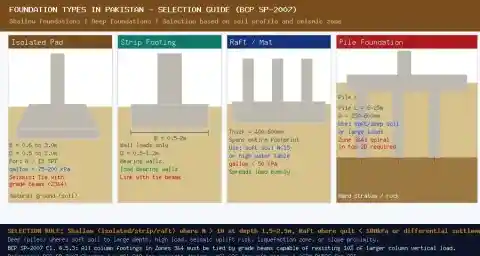
Foundation type selection in Pakistan is governed by the combination of column loads, soil bearing capacity, groundwater depth, seismic zone, and site-specific hazards. The general selection hierarchy is:
- Isolated pad footings: Use where N > 10–15 at bearing level (1.5–2.5m depth), loads are moderate (up to 1,500–2,000 kN per column), and differential settlement risk is low. The most common footing type in Pakistan for low to medium-rise construction on SD and SC soils.
- Strip footings: Use under bearing walls or lines of closely spaced columns where isolated footings would overlap. Also used under retaining walls and staircase walls.
- Raft (mat) foundations: Use where allowable bearing pressure is low (qallow < 75–100 kPa), loads are high relative to soil capacity, or where differential settlement must be minimised across a large plan area. Required on Type SE soils for multi-storey buildings. Minimum thickness is typically governed by two-way punching shear at column locations.
- Pile foundations: Use where soft or loose soils extend beyond 3–5m depth, where column loads are very large (> 3,000–4,000 kN), where seismic uplift must be resisted, or where liquefaction risk has been identified. Also required near active faults where surface rupture potential exists per BCP SP-2007 Section 3.2 (no important building within 200m of active fault trace).
Step 3: Bearing Capacity Calculation
The ultimate bearing capacity of soil under a footing is calculated using Terzaghi’s general bearing capacity equation for simple cases or Meyerhof’s extended equation for eccentric, inclined, or non-planar conditions.
Terzaghi’s General Bearing Capacity Equation:
qᵤₗₜ = c · Nᴄ + q · Nᨃ + 0.5 · γ · B · Nγ
where c is the soil cohesion (kPa), q = γ·Dᶠ is the overburden stress at the footing base (kPa), γ is the unit weight of soil (kN/m³), B is the footing width (m), and Nᴄ, Nᨃ, Nγ are dimensionless bearing capacity factors dependent on the soil friction angle φ. Common values: for φ = 30°: Nᴄ = 30.1, Nᨃ = 18.4, Nγ = 15.7. For φ = 25°: Nᴄ = 20.7, Nᨃ = 10.7, Nγ = 6.8.
The allowable bearing capacity is then:
qₐₗₗₒᵂ = qᵤₗₜ / FOS
The factor of safety (FOS) is typically 3.0 for gravity load combinations and 2.0 for seismic combinations. BCP SP-2007 Clause 4.5.2 specifically permits the allowable bearing capacity to be increased by one-third (i.e., FOS effectively reduced to approximately 2.25) for seismic load combinations, recognising the short-term dynamic nature of seismic loading. The friction and passive resistance of the soil may also be combined to resist horizontal seismic forces on footings.
SPT-based approximate bearing capacity (Meyerhof, 1956): For preliminary design, a widely used correlation for sandy soils is:
qₐₗₗₒᵂ (kPa) = 12 · N (for B ≤ 1.2m) or qₐₗₗₒᵂ = 8 · N · [(B+0.3)/B]² (for B > 1.2m)
where N is the average uncorrected SPT value at the bearing level and within depth B below the footing. These correlations are approximate and should be verified by laboratory testing on borehole samples for final design. Settlement must be checked separately: for sandy soils, Terzaghi and Peck’s chart or Meyerhof’s settlement equations are commonly used; for clay soils, the consolidation settlement method based on the compression index Cᴄ governs.
Step 4: Isolated Pad Footing Design (ACI 318-19)
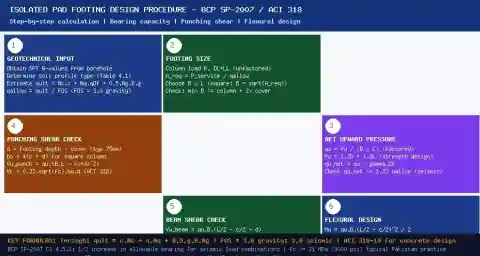
Isolated pad footing design follows the six-step procedure shown above. The critical details for Pakistani practice are:
Footing sizing: The footing area is determined using unfactored (service) loads: Aᴿᵉᵠ = Pₛᵉᴿᵥᵢᴄᵉ / qₐₗₗₒᵂ. For a square footing, B = √Aᴿᵉᵠ. Standard practice is to round up to the nearest 50mm or 100mm increment.
Punching shear (two-way shear): Almost always governs the footing depth. Per ACI 318-19 Cl. 22.6.5, the design punching shear strength is:
Vᴄ = 0.17 · λ · √f’ᴄ · b₀ · d (governs for square columns with b₀/d ratio typical of footings)
where b₀ is the critical perimeter at d/2 from column face = 4(c + d) for a square column of size c, and d is the effective depth. For the typical Pakistan concrete grade of 21 MPa (3,000 psi) and a square column, a useful starting approximation is d ≈ (qᵤ · (B² - (c+d)²)) / (0.17√f’ᴄ · 4 · (c+d)).
Flexural design: The critical bending moment occurs at the face of the column. For a square footing of side B with a square column of size c:
Mᵤ = qᵤ · B · (B - c)² / 8
The required steel area: Aₛ = Mᵤ / (0.9 · fʸ · 0.9d), where fʸ = 0.9d · fʸ is the moment arm approximation. Minimum temperature and shrinkage reinforcement per ACI 318 Cl. 24.4: Aₛ,ₘᵢₙ = 0.0018 · B · h. Concrete cover: 75mm minimum where footing is cast directly against earth, per ACI 318 Table 20.6.1.3.
Minimum footing depth: No specific minimum depth is stated in BCP SP-2007, but 1.0m below finished grade is standard Pakistani practice to avoid frost effects in northern regions and to maintain adequate passive resistance. In Islamabad and Rawalpindi, 1.2–1.5m below finished grade is common due to cold winters.
Step 5: Seismic Tie Requirements — Grade Beams (BCP SP-2007 Cl. 4.5.3)
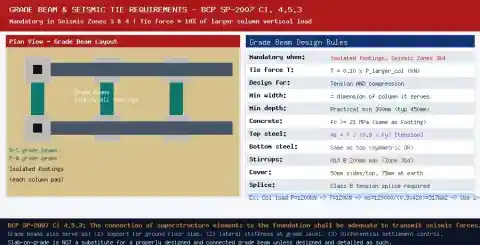
BCP SP-2007 Clause 4.5.3 requires that in Seismic Zones 3 and 4, individual column footings must be tied together by grade beams or a properly designed slab. This is one of the most commonly neglected requirements in Pakistani construction and one of the most structurally important. Its purpose is to prevent differential horizontal movement between adjacent footings during an earthquake, which would impose large moments and shear at the base of columns designed as fixed at the base.
The design tie force is 10% of the larger of the two connected column vertical loads:
T = 0.10 · Pₗₐᴿɡᵉᴿ [BCP SP-2007 Cl. 4.5.3]
The grade beam must be designed for this force in both tension and compression. The minimum width of the grade beam equals the dimension of the column it serves — so for a 300×450mm column, the grade beam is at least 450mm wide. A practical design: for a column load of 1,500 kN, T = 150 kN. Required steel: Aₛ = 150,000 / (0.9 × 420) = 397 mm². Use 2-H16 (402 mm²) — with 2-H16 bottom for the compression case as well. Stirrups: H10 @ 200mm maximum spacing for confinement in Zones 3 and 4.
Common design error: Using the ground floor slab as the grade beam without checking its capacity to resist 10% of column loads as a tension and compression tie. A 150mm plain or lightly reinforced slab with light mesh is typically incapable of resisting these forces, particularly in tension.
Step 6: Pile Foundation Design (BCP SP-2007 Cl. 4.5.5)
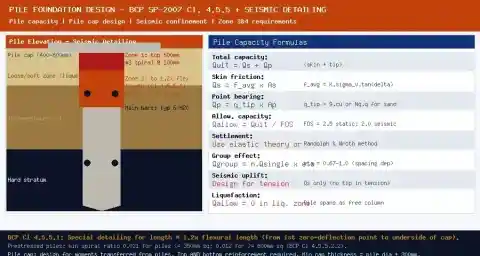
Where shallow foundations are not feasible, pile foundations transfer structural loads to deeper, more competent strata. The total pile capacity is the sum of skin friction and end bearing:
Qᵤₗₜ = Qₛ (skin friction) + Qₚ (end bearing)
For driven piles in sand: Qₛ = K · σᵥ · tan(δ) · Aₛ, where K is the lateral earth pressure coefficient (0.5–0.8 for driven piles), σᵥ is the average vertical effective stress along the pile, δ is the pile-soil friction angle (≈25° for steel, ≈33° for concrete in sand), and Aₛ is the pile surface area. Qₚ = Nᨃ · qₚ · Aₚ, where qₚ is the effective vertical stress at pile tip (limited to approximately 150 kPa for displacement piles), Nᨃ is the bearing capacity factor (typically 40–60 for medium-dense sand), and Aₚ is the pile cross-sectional area. The allowable pile capacity: Qₐₗₗₒᵂ = Qᵤₗₜ / 2.5 (gravity) or Qᵤₗₜ / 2.0 (seismic).
Seismic detailing requirements per BCP SP-2007 Cl. 4.5.5:
- Piles must be designed to transfer moments to the pile cap — they are not pins at the head.
- Special transverse reinforcement applies over a length equal to 1.2 times the flexural length, measured from the first point of zero lateral deflection to the underside of the pile cap (Cl. 4.5.5.1).
- For non-prestressed concrete piles: spiral reinforcement per ACI 318 Section 7.5 within this length.
- For prestressed concrete piles ≤ 350mm square: minimum volumetric spiral ratio = 0.021. For piles ≥ 600mm square: minimum = 0.012 (Cl. 4.5.5.2.2). Interpolate for intermediate sizes.
- Within the top 600mm: #3 (H10) spiral at 100mm maximum pitch regardless of other requirements.
- On liquefiable sites: skin friction in the liquefiable zone is set to zero; the pile must span as a free column between the non-liquefiable strata above and below, carrying both axial and lateral loads through the liquefied zone.
Step 7: Raft Foundation Design
Raft foundations are used in Pakistan primarily on soft or variable soils where isolated footings would be too large or too settlement-prone, and for buildings with closely spaced columns or basement construction. The raft distributes all column and wall loads uniformly to the subgrade.
Raft thickness: Governed by two-way (punching) shear at the most heavily loaded column. A practical initial estimate: h ≈ perimeter/180 (ACI rule of thumb). For a 400×600mm column, the critical perimeter at d/2 from the face is approximately (400+d+600+d)×2 = 2(1000+2d). Minimum thickness in Pakistani practice is typically 400mm; for heavily loaded structures, 600–900mm.
Bearing pressure: The net upward pressure q = (total factored column loads) / (raft area). This should be checked against the allowable bearing pressure. For raft foundations, a common approximation uses the Winkler subgrade modulus kₛ (kN/m³) to model the soil reaction as a bed of springs: kₛ = qₐₗₗ / δₐₗₗₒᵂ, where δₐₗₗₒᵂ is the tolerable settlement (typically 25mm for column differential, 50mm total). For SD soils in Pakistan, kₛ is approximately 20,000–30,000 kN/m³; for SE soils, kₛ may be as low as 10,000 kN/m³.
Reinforcement: A minimum reinforcement ratio of 0.0018bh (ACI 318 Cl. 24.4) applies in each direction on each face (top and bottom). For a 500mm raft: Aₛ,ₘᵢₙ = 0.0018 × 1000 × 500 = 900 mm²/m each direction each face, satisfied by H16 @ 200mm c/c (1,005 mm²/m). Additional reinforcement at column locations must resist the punching shear and the column moments transferred to the raft.
Step 8: Load Combinations for Foundation Design
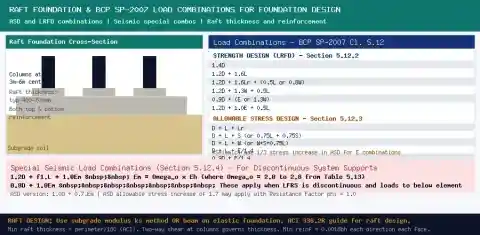
BCP SP-2007 Section 5.12 provides two sets of load combinations. For foundation sizing (bearing capacity check), Allowable Stress Design (ASD) combinations per Cl. 5.12.3 are used with service-level loads. For structural design of the concrete foundation elements, Strength Design (LRFD) combinations per Cl. 5.12.2 are used with factored loads.
Key load combinations for foundation design:
- Gravity governing (ASD): D + L — most common combination for bearing capacity check
- Gravity + seismic (ASD): D + L + E/1.4 — with 1/3 increase in allowable bearing stress permitted
- Strength, gravity: 1.2D + 1.6L — governs flexural design of footing
- Strength, seismic: 1.2D + 1.0E + 0.5L or 0.9D + 1.0E — the latter governs for uplift check
- Special seismic (Cl. 5.12.4): 1.2D + f₁L + Eₘ, where Eₘ = Ω₀ · Eₕ — applies to foundation elements supporting discontinuous lateral-force-resisting systems. Ω₀ = 2.0–2.8 from Table 5.13.
The 0.9D + E combination is critical for checking uplift under seismic overturning. For tall buildings with a small plan footprint, seismic overturning can cause net tension in outer footings or piles, requiring these elements to be designed for the tensile force. In ASD, the equivalent check is D + E/1.4 with no live load, using the 1/3 stress increase.
Overturning at the soil-foundation interface (BCP Cl. 4.5.4 and 5.30.8): The overturning moment from seismic forces must be carried down to the foundation-soil interface. BCP SP-2007 Cl. 4.5.4 notes that for regular buildings, the top concentrated force Fₜ may be omitted when determining the overturning moment at the foundation-soil interface — a minor but potentially useful reduction. ASD may be used for soil-structure interface checks regardless of whether the superstructure uses Strength Design.
Step 9: Liquefaction Assessment (BCP SP-2007 Chapter 3)
BCP SP-2007 Section 3.3 requires that sites in Seismic Zones 3 and 4 with potentially liquefiable soils be assessed for liquefaction potential before foundation design proceeds. Liquefiable conditions are most commonly found where: loose to medium dense saturated cohesionless soils exist (N₁₆₀ < 15–22 depending on fines content), groundwater is within 5–7m of ground surface, and grain size is fine to medium sand. These conditions are prevalent in the Indus and Jhelum flood plains — areas that include parts of Hyderabad, Sukkur, Faisalabad, Gujranwala, and Sheikhupura.
The cyclic stress ratio (CSR) induced by the earthquake is compared with the cyclic resistance ratio (CRR) of the soil. A simplified SPT-based approach (Seed and Idriss, updated by Youd et al. 2001) is standard:
CSR = 0.65 · (σᵥ/σ’ᵥ) · (aₘₐˣ/g) · rᴅ
where σᵥ and σ’ᵥ are the total and effective vertical stresses at the layer in question, aₘₐˣ is the peak ground acceleration (= Z × g for the seismic zone), and rᴅ is the stress reduction factor (≈1.0 for depths ≤ 9m). If CSR > CRR, liquefaction is predicted and mitigation is required.
Where liquefaction is confirmed, foundation options in Pakistani practice include: deep piles to non-liquefiable strata (with the liquefiable layer treated as a free length providing zero resistance), ground improvement by vibro-compaction or stone columns (achieving N₁₆₀ > 25–30 throughout the critical layer), densification by dynamic compaction, or grouting. The choice depends on project scale, site access, and cost.
Practical Minimum Requirements Summary for Pakistan
- Minimum footing depth: 1.0m below finished grade; 1.2–1.5m in northern provinces (frost); 0.9m absolute minimum.
- Concrete grade: f’ᴄ ≥ 21 MPa (3,000 psi) for all foundations; f’ᴄ ≥ 25 MPa for pile caps and grade beams in Zone 3 and 4.
- Reinforcement grade: fʸ = 420 MPa (Grade 60) throughout. Deformed bars (ribbed) required.
- Cover: 75mm where concrete cast against soil; 50mm for sides and top of footings and grade beams.
- Grade beams: Mandatory in Zones 3 and 4 between all isolated column footings. Tie force = 10% of larger column load. Min width = column dimension.
- Footing on rock: Bond to rock using dowels; minimum embedment 150mm into rock; no bearing capacity reduction needed for SA/SB profiles.
- Factor of safety: FOS = 3.0 (gravity); 2.0–2.25 (seismic). Settlement limit: 25mm differential, 50mm total for ordinary structures.
- Site investigation minimum: One borehole per isolated footing position for important structures; minimum depth = 1.5B below proposed footing base or to refusal, whichever is greater.
Final Thoughts
Foundation design in Pakistan requires a disciplined integration of geotechnical data, BCP SP-2007 seismic requirements, and ACI 318 structural design — none of which can be applied in isolation. The most consequential decisions are made early: the soil investigation scope, the soil profile classification, the foundation type selection, and the determination of the seismic zone. A foundation designed without a proper borehole, or with an assumed profile that is not verified by testing, or in a Seismic Zone 3 or 4 site without grade beams or pile confinement, is a foundation that has been designed without the minimum information and requirements the code demands. The October 2005 earthquake in Pakistan demonstrated in devastating detail what happens when foundation and structural systems are designed without adequate seismic provisions — and the BCP SP-2007 provisions exist precisely to prevent that from happening again.


Be the first to comment.