Foundation design in seismically active zones is one of the most technically demanding aspects of structural engineering, and the provisions of BCP SP-2007 Chapter 4 reflect that reality. While much of the discussion around Pakistan’s seismic code focuses on the superstructure — lateral forces, moment frames, shear walls, and drift limits — the foundation system is where those forces are ultimately resolved into the ground. In Seismic Zones 3 and 4, which cover the most hazardous parts of Pakistan including much of the northwest, the Balochistan fold belt, and zones affected by the October 2005 earthquake, BCP SP-2007 imposes specific and demanding requirements that go well beyond standard geotechnical practice.
Soil Profile Classification and Its Effect on Seismic Demand
Before any foundation can be designed, the soil profile type must be established per Section 5.29.3 and Table 4.1 of BCP SP-2007. The code defines six soil profile types, SA through SF, based on shear wave velocity, standard penetration resistance, and undrained shear strength measured over the upper 30 metres of the soil profile. The importance of this classification cannot be overstated: the seismic coefficients Cₐ and Cᵥ, which directly set the base shear, are substantially amplified for softer soils. Type Sₐ (rock) produces the lowest seismic demand, while Type Sᴇ (soft clay, defined as more than 3 metres of clay with undrained shear strength less than 25 kPa) produces the highest, and Type Sᶠ (site requiring site-specific evaluation, including peat, highly sensitive clays, and deep soft deposits) is outside the standard tabulated values entirely and requires a site-specific hazard analysis.
When soil properties cannot be determined to sufficient detail, the code defaults to Type Sᴅ in Zones 3 and 4. This is a deliberate conservative assumption: Sᴅ produces higher seismic coefficients than Sᴄ or stiffer profiles, ensuring that unknown soil conditions do not result in under-design. Engineers should note that Sᴇ need not be assumed unless either the engineer determines it may be present or geotechnical data establishes it — but the burden of demonstrating a more favourable profile rests on the engineer to substantiate with actual test data.
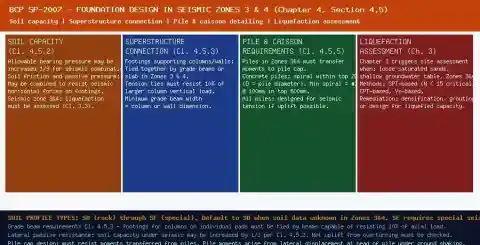
Soil Capacity for Seismic Load Combinations (Section 4.5.2)
For seismic load combinations, BCP SP-2007 allows the allowable bearing pressure and the allowable passive pressure of the soil to be increased by one-third compared to values used for gravity or wind combinations. This increase reflects the transient, dynamic nature of seismic loading and its relatively low probability of coinciding with sustained peak live loads. It should be noted that this is an increase in allowable stress, not in actual soil capacity — the underlying geotechnical properties are unchanged. If the foundation design is controlled by seismic combinations, this increase can meaningfully reduce footing sizes, but the engineer must verify that the unreduced gravity combination still governs overall footing proportioning.
Section 4.5.2 also permits soil friction and passive pressure to be combined in resisting horizontal seismic forces on footings. In gravity design, passive resistance alone is typically used. Under seismic conditions, the friction component — calculated as the product of the normal force and the coefficient of friction between the footing base and the soil — may be added directly to passive resistance to establish the total horizontal capacity of the footing. For sites with good soil-footing friction characteristics, this combination can avoid the need for supplemental shear keys or grade beam connection to resist lateral forces.
Superstructure-to-Foundation Connection Requirements (Section 4.5.3)
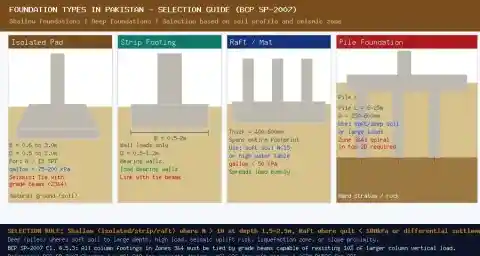
One of the most specific and least negotiable requirements of BCP SP-2007 for Zones 3 and 4 is the mandatory interconnection of column and wall footings. Section 4.5.3 requires that individual column or wall footings be tied together by grade beams or slabs capable of resisting a tension or compression force equal to 10% of the larger column vertical load. This requirement exists because differential settlement or differential horizontal movement of individual footings during an earthquake can introduce very large forces at column bases if the footings are free to move independently. The grade beam or tie slab provides a continuous, redundant load path that limits relative displacement between adjacent footings.
The grade beam must have a clear width at least equal to the largest dimension of the column or wall it supports, and must be reinforced to carry the specified tension force. This requirement is sometimes overlooked on sites where the ground floor slab on grade is assumed to serve as a tie, but a plain or lightly reinforced slab on grade without adequate connection detailing does not satisfy the code requirement. A properly detailed tie slab with perimeter beams, or dedicated grade beams between all column footings, is required.
Special Requirements for Piles and Caissons (Section 4.5.5)
Pile foundations in Seismic Zones 3 and 4 are subject to requirements that go significantly beyond those in lower seismic zones, reflecting the complexity of pile-soil interaction under earthquake loading and the documented failure of pile heads in past Pakistani earthquakes. Section 4.5.5 requires that piles and caissons in these zones be designed to transfer moments to the pile cap. This is a critical departure from non-seismic practice, where piles are commonly designed as pinned at the head. Under seismic loading, inertial forces from the superstructure impose moment demands at the pile head that can be substantial, and a pile designed without moment capacity at the head will form a plastic hinge at that location without the confinement needed to maintain axial load capacity through large inelastic deformations.
For concrete piles, BCP SP-2007 requires special transverse reinforcement within the top two pile diameters. Within the top 600mm, a minimum #3 spiral at 100mm pitch is required; from 600mm to the two-diameter depth, this reduces to the same spiral at a slightly relaxed pitch. The intent is to provide confinement that maintains core concrete integrity through the cyclic moment demands at the pile head. Piles must also be designed for seismic tension forces where the net effect of overturning could produce uplift, and pile caps must be explicitly designed to resist the transferred moments. In practice, this means a properly reinforced pile cap with top and bottom reinforcement, not simply a mass concrete pad sized for gravity bearing.
Liquefaction Assessment (Chapter 3)
Chapter 3 of BCP SP-2007 requires assessment of liquefaction potential at sites in Seismic Zones 3 and 4 where conditions are conducive: loose saturated cohesionless soils, shallow groundwater tables, and fine to medium grain sizes. Liquefaction — the sudden loss of shear strength in saturated granular soil subjected to cyclic loading — was one of the primary failure modes observed in the 2005 earthquake in Pakistan, and its consequences include bearing capacity failure, lateral spreading, differential settlement, and loss of pile lateral resistance.
The SPT-based liquefaction assessment remains the most commonly used method in Pakistani practice. The critical SPT value Nₜ₁₆₀ below which liquefaction is considered probable varies with the fines content and the cyclic stress ratio at the site, but as a practical rule of thumb, uncorrected N-values below 15 in saturated clean sands at a Zone 3 or 4 site warrant detailed assessment. CPT-based and shear wave velocity-based methods are recognised alternatives and may be more reliable in stratified profiles where SPT variability is high.
Where liquefaction is assessed as probable, the code requires either ground improvement (densification, stone columns, dynamic compaction), grouting, or design of the structure for the reduced capacity of the liquefied or partially liquefied soil. For pile foundations on potentially liquefiable sites, the pile must be designed assuming that the liquefiable layer provides no lateral resistance or skin friction during the earthquake — the pile must span between the non-liquefiable layers above and below, carrying both axial and lateral seismic load through the liquefiable zone as if it were a free length.
Overturning at the Foundation Level
Section 5.30.8.3 of BCP SP-2007 requires that overturning moments be carried down to the foundation soil interface. For tall, narrow structures or structures with high seismic forces, overturning can produce significant net uplift under individual footings or pile groups. The code explicitly notes that Allowable Stress Design may be used to evaluate sliding or overturning at the soil-structure interface, even when the superstructure is designed using Strength Design. This allows the use of unfactored loads for soil interaction checks, which reflects the difficulty of reliably establishing ultimate limit states for soil behaviour.
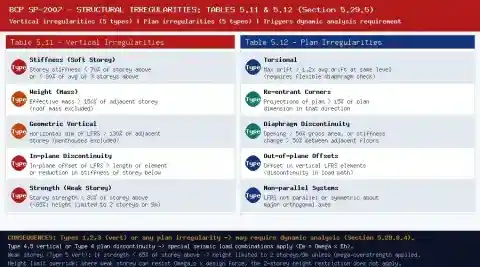
Where elements of the lateral-force-resisting system are discontinuous — such as shear walls that do not extend to the foundation or columns that support discontinuous shear walls — the supporting foundation elements must be designed using the special seismic load combination Eₘ = Ω₀ Eₕ. The seismic force amplification factor Ω₀, taken from Table 5.13, typically ranges from 2.0 to 2.8 for common structural systems. Applying Ω₀ to the foundation elements supporting a discontinuous system substantially increases their required size and reinforcement, but accurately captures the potential peak force demand at those critical load transfer points.
Final Thoughts
Foundation design in Pakistan’s Seismic Zones 3 and 4 under BCP SP-2007 requires the coordinated application of geotechnical and structural disciplines in a way that is often more demanding than in lower-seismic regions. The mandatory grade beam ties between column footings, the confinement requirements for pile heads, the liquefaction assessment obligations, and the requirement to carry overturning to the soil-structure interface are not administrative formalities — they address specific failure modes documented in actual Pakistani earthquakes. Engineers who treat the foundation design as a geotechnical afterthought to the superstructure analysis, rather than as an integral part of the seismic load path, risk producing structures where the superstructure detailing is exemplary but the foundation cannot deliver the forces to the ground in the way the analysis assumed.
Be the first to comment.