
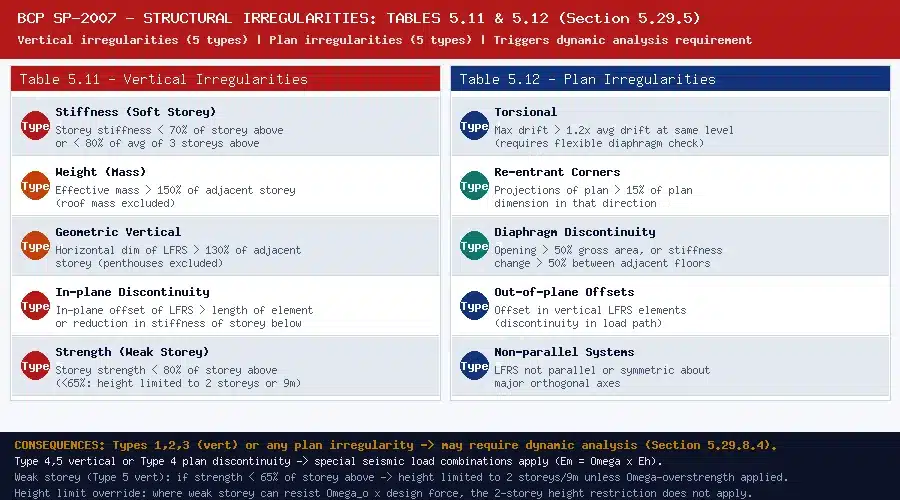
One of the most consequential — and most frequently misapplied — sections of BCP SP-2007 is its treatment of structural irregularities. Sections 5.29.5 and the associated Tables 5.11 and 5.12 classify buildings as either regular or irregular based on measurable physical characteristics, and that classification directly determines which analysis procedure is mandatory, what height limits apply, and which special seismic load combinations must be satisfied. A building that appears straightforward in architectural terms may carry multiple code-defined irregularities that fundamentally change the complexity and conservatism of its seismic design.
Why Irregularity Classification Matters
BCP SP-2007 Section 5.29.8 defines when the static force procedure (Section 5.30) may be used and when dynamic analysis (Section 5.31) is mandatory. The key trigger for dynamic analysis under Section 5.29.8.4 is the presence of vertical irregularity Types 1, 2, or 3, or specific plan irregularities, in structures over five storeys or 20 metres in height in Seismic Zones 3 and 4. For irregular structures subjected to dynamic analysis, the resulting base shear cannot be reduced below 100% of the static procedure base shear — unlike regular structures, which may reduce to 80% or 90% depending on the ground motion representation used.
The practical consequence is that classifying a building as irregular has both a direct cost (additional analysis effort) and an indirect cost (higher minimum design forces after analysis). Understanding exactly which characteristics trigger which classification is therefore not an academic exercise — it is a design decision that affects project cost, schedule, and safety.
Vertical Irregularities (Table 5.11)
Type 1: Stiffness Irregularity (Soft Storey). A soft storey exists when the lateral stiffness of any storey is less than 70% of the storey above it, or less than 80% of the average stiffness of the three storeys above. This is one of the most common irregularities in Pakistani construction, arising wherever a ground floor is left open for retail or parking while upper floors are stiffened by masonry infill or shear walls. The remedy is either to stiffen the soft storey explicitly — by adding moment frames or shear walls — or to carry the irregularity through the dynamic analysis with the higher design forces it triggers. The code provides an exception: if no storey drift ratio under design lateral forces exceeds 1.3 times the drift ratio of the storey above, the structure need not be classified as Type 1 or Type 2 irregular.
Type 2: Weight (Mass) Irregularity. A mass irregularity exists when the effective mass of any storey is more than 150% of the effective mass of an adjacent storey. Roof masses are excluded from this comparison. This irregularity most commonly arises where a heavy plant room, water storage tank, or mechanical floor is located at an intermediate level, substantially increasing the mass at that storey relative to those above and below it. The concentration of mass changes the dynamic response significantly, amplifying forces at that level.
Type 3: Vertical Geometric Irregularity. This irregularity exists where the horizontal dimension of the lateral-force-resisting system at any storey is more than 130% of that in an adjacent storey. Setbacks — very common in Pakistani residential and commercial tower construction — frequently introduce this irregularity. Penthouse structures are excluded. The geometric change concentrates forces at the setback level because the load path must transfer through the diaphragm from the wider system below to the narrower system above.
Type 4: In-plane Discontinuity. An in-plane discontinuity in the lateral-force-resisting system exists where there is a horizontal offset — in plan — of the vertical resisting elements greater than the length of those elements, or where there is a reduction in stiffness of the lateral-force-resisting system in the storey below a discontinuity. This is particularly common where shear walls are used: if a shear wall is offset in plan from one floor to another, the load must transfer horizontally through the diaphragm over that offset distance, and the diaphragm and supporting columns must be designed for the resulting special seismic forces (Eₘ = Ω₀ Eₕ) per Section 5.12.4.
Type 5: Strength Irregularity (Weak Storey). This is the most dangerous irregularity. A weak storey is one whose lateral strength is less than 80% of the storey above. Where the weak storey has less than 65% of the strength of the storey above, the structure may not exceed two storeys or 9 metres in height — unless the weak storey is explicitly designed to resist a lateral force of Ω₀ times the code design force. The distinction between a soft storey (stiffness deficiency) and a weak storey (strength deficiency) is critical: a storey can be soft but not weak, or weak but not soft, or both simultaneously. Both require separate assessment.
Plan Irregularities (Table 5.12)
Type 1: Torsional Irregularity. Torsional irregularity exists when the maximum storey drift at one end of the diaphragm is more than 1.2 times the average storey drift at the two ends, where the diaphragm is not flexible. This irregularity is triggered by an asymmetric distribution of lateral stiffness — a common condition when shear walls are grouped on one side of a building, or when the centre of mass and centre of rigidity are widely separated. Its design consequence under BCP SP-2007 is mandatory amplification of the accidental torsion by the factor Aˣ = (δₘₐˣ / 1.2δₐᵥɡ)², calculated at each level where the irregularity exists.
Type 2: Re-entrant Corner Irregularity. This exists where plan projections of the structure are greater than 15% of the plan dimension in that direction. L-shaped, T-shaped, U-shaped, and cross-shaped plan buildings will commonly meet this threshold. The concern is stress concentration at the re-entrant corner under earthquake loading, where the two wings of the building tend to respond independently and can impose large forces at the corner connection.
Type 3: Diaphragm Discontinuity. This irregularity is triggered by large openings in the diaphragm — greater than 50% of the gross enclosed area — or by stiffness changes greater than 50% between adjacent floors. Buildings with large atriums, voids, or heavily perforated floor plates must be assessed against this criterion. Where diaphragm discontinuity exists, the load path from floor to lateral-force-resisting elements must be traced explicitly, and collector elements must be designed for the forces they attract.
Type 4: Out-of-plane Offsets. This is the plan counterpart of the vertical Type 4 irregularity: it exists where vertical elements of the lateral-force-resisting system are offset out-of-plane relative to their position at adjacent floors. The load transfer through the diaphragm at the offset level must resist the special seismic forces from Section 5.12.4 using Eₘ = Ω₀ Eₕ.
Type 5: Non-Parallel Systems. This irregularity is triggered when the lateral-force-resisting system is neither parallel nor symmetric about the major orthogonal axes of the building. Buildings with diagonal or radially arranged shear walls, or irregular grid structures, will trigger this classification. The design requirement is that orthogonal effects must be considered: elements must be designed for 100% of the seismic force in one direction plus 30% in the perpendicular direction.
Structural System Selection and Its Relationship to Irregularity
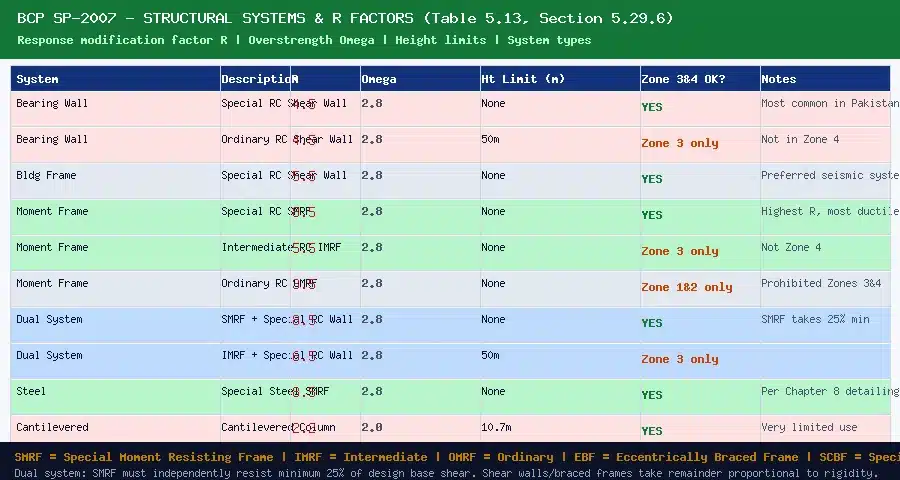
The structural system selected from Table 5.13 interacts directly with how irregularity is handled. Systems with lower R values — such as ordinary shear walls (R = 4.5) or bearing wall systems — are more restricted in their ability to accommodate irregularities because they have less inherent ductility to redistribute forces when the load path is disrupted. Systems with high R values — SMRF with R = 8.5 — are capable of redistributing forces through multiple ductile mechanisms, making them more tolerant of moderate irregularity when properly detailed. For structures in Zones 3 and 4 with multiple irregularities, the dual system (SMRF + special shear walls) with its redundant load paths and R = 8.5 is the most appropriate system from a code compliance standpoint.
The design implication of Table 5.13 for Pakistani practice is also significant in terms of what is prohibited. Ordinary RC moment frames (OMRF, R = 3.5) cannot be used in Seismic Zones 3 or 4. Intermediate RC moment frames (IMRF, R = 5.5) are prohibited in Zone 4. In the high-seismic zones that cover much of northern and western Pakistan, only Special Moment Resisting Frames, special shear wall systems, and dual systems carry full code compliance, and all require the specific detailing mandated in Chapter 7 of BCP SP-2007.
Final Thoughts
Identifying and classifying structural irregularities is one of the first — and most consequential — steps in a BCP SP-2007 seismic design. An irregularity missed at the classification stage means a dynamic analysis not performed where required, accidental torsion amplification not applied, overstrength forces not used for discontinuous system supports, and potential non-compliance that is only discovered during checking or — far worse — during an earthquake. The definitions in Tables 5.11 and 5.12 are measurable and quantitative: they can be checked systematically during the preliminary design stage, and the structural layout can often be adjusted to eliminate or reduce irregularities before detailed analysis begins.
