
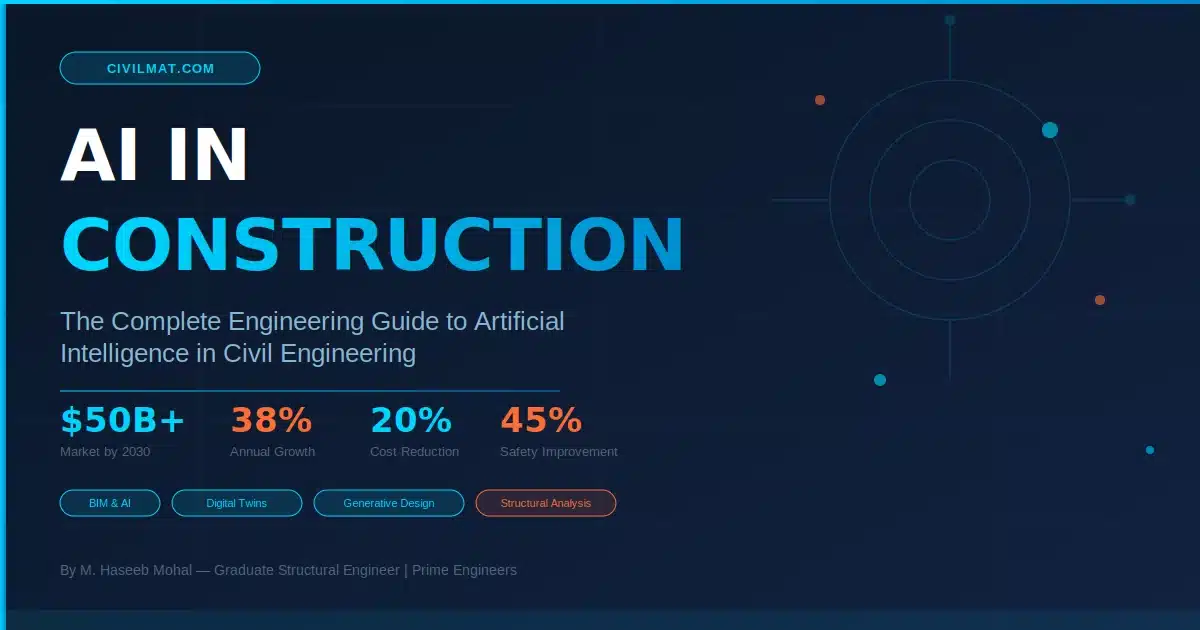
Artificial intelligence is no longer a future concept in the construction industry — it is actively reshaping how civil engineers design, build, and manage infrastructure right now. From AI-powered BIM clash detection that reduces rework by 40% to computer vision systems that monitor PPE compliance in real time, the transformation is measurable, technical, and commercially significant. If you are evaluating AI tools for your next project, making a procurement decision, or simply trying to understand where this technology is headed, this is the definitive resource you need.
The global AI in construction market was valued at approximately $2.8 billion and is projected to exceed $50 billion by 2030, growing at a compound annual growth rate (CAGR) of 38% — a pace that outstrips every other engineering sector. According to McKinsey Global Institute, adopting AI-driven workflows can reduce total project costs by 15–20% and cut schedule overruns by up to 35%. These are not marketing figures; they are measured outcomes from real infrastructure projects.
This guide breaks down every major AI application in construction — structural analysis, generative design, safety monitoring, project scheduling, cost estimation, quality control, and digital twins — with the specific algorithms, tools, cost-benefit data, and engineering formulas you need to evaluate and implement them. We also examine where AI currently fails and what that means for practicing engineers.
- What Is AI in Construction? Core Technologies Explained
- AI in Structural Analysis and Engineering Design
- Generative Design and BIM — How AI Redesigns Architecture
- AI-Powered Safety Monitoring on Construction Sites
- AI for Project Scheduling and Delay Prediction
- AI-Driven Cost Estimation: From ±20% to ±3%
- Drone + AI Quality Control and Defect Detection
- Digital Twins in Construction — Live Project Intelligence
- Top AI Construction Software — Comparison Table
- Where AI Fails in Construction — Honest Assessment
- How to Implement AI on Your Construction Project
- FAQs — AI in Construction
What Is AI in Construction? Core Technologies Explained
Before evaluating specific applications, engineers need a working understanding of which AI paradigms are actually being deployed in construction contexts — not the marketing language, but the actual algorithms under the hood.
Machine Learning (ML) — Pattern Recognition at Scale
Machine learning algorithms train on historical project data to identify patterns invisible to human analysts. In construction cost estimation, a Random Forest or Gradient Boosting model trained on 10,000+ historical projects can predict final contract cost within ±3–5%, compared to ±15–20% from traditional quantity surveying. The algorithm learns correlations between project parameters (floor area, structural type, location index, soil conditions) and historical cost outcomes.
Supervised learning dominates most current applications: training on labeled datasets of defect images to detect cracks, classifying safety hazards in CCTV footage, predicting delays from weather and resource data. Unsupervised learning is emerging for anomaly detection in IoT sensor streams from structural health monitoring systems.
Computer Vision (CV) — Eyes on the Site
Computer vision uses convolutional neural networks (CNNs) — most commonly ResNet-50, YOLO v8, or Detectron2 architectures — to analyze image and video streams. On construction sites, CV performs two primary functions: safety monitoring (PPE detection, restricted zone violation, equipment proximity alerts) and quality inspection (crack detection in concrete, rebar placement verification, surface defect mapping).
The commercially deployed systems (Smartvid.io, Doxel, Buildots) typically achieve 92–97% precision on well-defined tasks like hard hat detection. Crack detection in concrete surfaces using trained CNNs achieves crack width resolution down to 0.1 mm, well within the AS 3600 / ACI 318 structural serviceability limits.
Natural Language Processing (NLP) — Contract and Code Intelligence
Large language models (LLMs) are being adapted for construction-specific tasks including contract risk clause extraction, specification compliance checking (cross-referencing design documents against building code requirements), and RFI (Request for Information) triage. Tools like Kira Systems and LexCheck parse contract language at scale — a task that previously required weeks of legal review.
Practical tip: LLM-based specification checkers work best when your project BIM model is linked to a structured specification database. The AI can then flag when a wall type specified in Revit differs from what the 50-page specification document requires — automatically, in seconds.
AI in Structural Analysis and Engineering Design
Structural analysis is where AI delivers perhaps the most technically significant gains — not by replacing finite element analysis (FEA) software, but by accelerating and augmenting it in ways that change what is computationally feasible within a project timeline.
ML Surrogate Models for FEA Acceleration
Traditional nonlinear finite element analysis of a large reinforced concrete (RC) frame under seismic loading can take 4–72 hours depending on model complexity, number of load steps, and element count. This bottleneck makes probabilistic analysis (Monte Carlo simulation of 10,000+ load cases) practically infeasible for most project budgets.
AI surrogate models — typically Gaussian Process Regression (GPR), Neural Network regression, or Physics-Informed Neural Networks (PINNs) — are trained on a representative FEA dataset to predict structural response (peak drift, base shear, hinge formation) as a function of input parameters. Once trained, the surrogate model evaluates each new case in milliseconds rather than hours, enabling:
- Full Monte Carlo seismic fragility analysis within design office timescales
- Sensitivity analysis across geometric and material parameters
- Real-time structural performance feedback during generative design optimization
- Reliability-based design optimization (RBDO) that traditional tools cannot run
A 2023 study published in Engineering Structures demonstrated that a trained deep neural network surrogate for RC frame pushover analysis achieved R² > 0.98 (prediction accuracy) while reducing computation time by 99.7% — from 6 hours to under 1 second per analysis.
Seismic Performance Prediction Using Deep Learning
The Maximum Interstory Drift Ratio (MIDR) is the critical structural performance parameter for seismic design. Traditional computation requires full nonlinear time-history analysis (NLTHA). AI-based approaches using LSTM (Long Short-Term Memory) recurrent neural networks can predict MIDR from ground motion intensity measures with accuracy comparable to NLTHA, at a fraction of the cost.
The prediction model takes ground motion parameters — PGA (Peak Ground Acceleration), Sa(T₁) (spectral acceleration at fundamental period), Arias Intensity (Ia) — as inputs and predicts structural response. The relationship can be expressed as:
SEISMIC DEMAND MODEL (AI-PREDICTED):
ln(MIDR) = a0 + a1·ln(Sa(T1)) + a2·ln(PGA) + a3·T1 + fNN(θ, X)
Where fNN(θ, X) is the neural network correction term that captures nonlinear interactions between ground motion parameters and structural characteristics that cannot be captured by simple regression.
Reinforcement Learning for Structural Optimization
Reinforcement learning (RL) treats structural design as an optimization problem where an agent iteratively modifies member sizes, cross-sections, and topology to minimize an objective function (typically material volume or cost) subject to design code constraints. Unlike gradient-based optimization, RL can escape local minima and handle highly non-convex design spaces — making it effective for topology optimization of steel connection details and truss geometries.
Commercially, tools like Autodesk Fusion 360 Generative Design and Altair OptiStruct incorporate these algorithms. Research implementations using OpenAI Gym-compatible structural environments have demonstrated 30–45% material savings over code-minimum designs in optimized steel structures.
⚠ ENGINEERING REALITY CHECK
AI surrogate models for structural analysis are powerful within their training domain. Extrapolating beyond the parameter space used for training produces unreliable results. Always validate surrogate model predictions against independent FEA runs for novel configurations, and never rely solely on AI predictions for life-safety structural design without peer review. The engineer of record remains legally and professionally responsible.
Generative Design and BIM — How AI Redesigns Architecture
Generative design applies AI optimization algorithms to explore thousands of design alternatives simultaneously, filtered against structural, functional, and regulatory constraints. It represents the most commercially mature AI application in the design phase of construction projects.
How Generative Design Works in Practice
The workflow begins with engineers defining:
- Design objectives: Minimize structural weight, maximize natural light ingress, minimize embodied carbon
- Constraints: Floor-to-ceiling heights, fire compartmentation zones, AS 1170 / ASCE 7 wind loads, AS 3600 / ACI 318 structural requirements
- Design space: Allowable ranges for column spacing, floor plate depth, facade angle
The AI then uses evolutionary algorithms (NSGA-II, genetic algorithms) or topology optimization (SIMP method) to iterate through thousands of compliant configurations, presenting a Pareto front of optimal trade-off solutions. Engineers then select from viable candidates that no single human designer would have proposed.
The Autodesk-documented example of MX3D’s 3D-printed steel bridge in Amsterdam used AI generative design to create a topology-optimized form that is 40% lighter than an equivalent welded steel design while maintaining full structural integrity. The bridge incorporates in-structure fiber optic sensors for real-time load monitoring, demonstrating how generative design and digital twinning converge.
AI-Powered BIM Clash Detection and Coordination
BIM clash detection is already mainstream, but AI elevates it beyond geometric intersection checks. Autodesk Construction Cloud’s AI layer and Trimble Connect AI now perform:
- Semantic clash detection: Not just “pipe intersects beam” but “high-pressure gas line within 300 mm of electrical conduit — AS 4645.3 clearance violation”
- Predicted clash hotspots: ML models trained on historical clash databases predict where clashes are most likely to occur in novel projects — before modeling is complete
- Coordination sequence optimization: AI determines the optimal installation sequence to minimize downstream clashes as trades progress
Reported outcomes from Autodesk’s 2023 State of BIM report indicate that AI-enhanced BIM coordination reduces RFI volume by 25–40% and reduces construction-phase rework costs by an average of $250,000 per project on projects over $50M in contract value.
AI-Powered Safety Monitoring on Construction Sites
Construction remains one of the most dangerous industries globally. In Australia, the construction sector accounts for approximately 25% of all workplace fatalities despite comprising only 9% of the workforce. In the United States, 1 in 5 worker deaths occurs in construction (OSHA data). AI safety monitoring systems are demonstrating measurable, commercially validated improvements in these statistics.
Computer Vision PPE and Behavior Monitoring
Deployed systems use cameras feeding real-time video to AI inference engines that simultaneously track multiple safety parameters at 15–30 frames per second. Detection tasks include:
- PPE compliance: Hard hat presence, high-visibility vest, safety glasses, gloves — with person-level tracking so individual violation events are logged
- Zone enforcement: Exclusion zone violation detection around plant, excavations, and overhead lift areas
- Ergonomic risk: AI pose estimation (MediaPipe, OpenPose) identifies high-risk postures (>90° trunk bend, overhead reach) that predict musculoskeletal injury
- Fatigue detection: Eye tracking and micro-expression analysis to detect operator fatigue in crane and HV plant operators
Smartvid.io’s published case study data from 50+ construction projects reports a 45% reduction in recordable safety incidents and a 60% reduction in near-miss events over a 12-month deployment period. The ROI calculation is straightforward: a single recordable injury costs an average of $38,000 in direct costs plus $150,000+ in indirect costs (lost productivity, insurance, regulatory compliance), making safety AI systems economically attractive even at significant subscription costs.
Predictive Safety — Incident Prevention Before It Happens
The most advanced AI safety systems move beyond reactive detection to predictive incident prevention. These systems train on a combination of:
- Historical safety incident data (type, location, time, weather, crew demographics, task being performed)
- Real-time site conditions (temperature, humidity, noise levels, congestion metrics from video)
- Schedule data (high-pressure deadline periods correlate with elevated incident rates)
- Workforce data (experience level, shift length, time since last break)
The output is a dynamic safety risk score for each work zone, updated at 15-minute intervals, that site supervisors can act on proactively — adjusting crew deployment, calling mandatory tool-box talks, or escalating to management.
⚡ INDUSTRY CANDID INSIGHT
As a structural engineer working on commercial projects, I have personally observed the gap between AI safety monitoring marketing claims and implementation reality. The technology works — but only when cameras have clear sight lines (not always achievable on complex sites), when workers understand they are being monitored (reducing behavioral compliance theater), and when supervision actually acts on alerts rather than ignoring them.
The biggest failure mode in AI safety deployments is not the technology — it is alert fatigue. Systems configured too sensitively generate hundreds of false positives per day, causing supervisors to ignore legitimate warnings. Proper threshold calibration and graduated alert escalation protocols are as important as the AI system itself. This is something vendors do not advertise prominently.
AI for Project Scheduling and Delay Prediction
Construction project delays cost the global industry an estimated $1.6 trillion annually (Oxford Said Business School). An analysis of 16,000+ large infrastructure projects found that 98% were delivered late or over budget, with an average cost overrun of 80%. AI scheduling systems are specifically engineered to address the systemic failures that cause these overruns.
How AI Schedule Optimization Works
Alice Technologies is the most mature commercially deployed AI scheduling platform for construction. Its core algorithm uses constraint satisfaction programming with genetic algorithm optimization to evaluate millions of construction sequence variants and identify the optimal schedule considering:
- Task dependencies and construction logic constraints
- Resource availability (crew size, equipment fleet, material lead times)
- Site spatial constraints (congestion modeling, crane reach zones)
- Weather probability distributions for weather-sensitive activities
- Cash flow and payment milestone constraints
On a documented $1.2B data center project, Alice Technologies identified a schedule optimization that saved $15M in acceleration costs by resequencing 380 activities — an analysis that human schedulers had not identified despite months of planning. The AI evaluated 6 million schedule variants in the time it would take a human scheduler to review 10.
Delay Prediction Using Historical Data
ML-based delay prediction models are trained on historical project datasets and then applied to monitor ongoing projects for early warning signals. The key leading indicators that predict downstream delays include:
| Delay Predictor | Data Source | Predictive Power | Typical Lead Time |
|---|---|---|---|
| RFI Volume Spike | BIM/PM Software | High — R²=0.74 | 3–6 weeks |
| Material Procurement Lag | ERP / Supply Chain | Very High — R²=0.81 | 4–12 weeks |
| Labour Attendance Anomaly | Site Access Systems | Medium — R²=0.61 | 1–3 weeks |
| Design Change Volume | Document Control | High — R²=0.77 | 6–20 weeks |
| Subcontractor NCR Rate | Quality Management | Medium — R²=0.58 | 2–8 weeks |
| Cash Flow Deviation | Financial Systems | High — R²=0.79 | 8–24 weeks |
Source: Compiled from peer-reviewed construction project analytics research (2020–2024). R² values from cross-validated ML model training.
AI-Driven Cost Estimation: From ±20% to ±3%
Traditional quantity surveying and cost estimation at the concept design stage carries inherent uncertainty of ±20–30%. This uncertainty forces clients to hold excessive contingency, sometimes killing economically viable projects. AI-based estimation using historical project data, parametric cost models, and real-time market pricing intelligence can compress this uncertainty to ±3–5% at concept stage — a transformative improvement for project feasibility decisions.
The AI Cost Estimation Model Architecture
The most accurate AI cost models combine three data sources:
- Historical project database: Completed project costs normalized to a cost index, parameterized by building type, structural system, location, procurement route, contract type, and market conditions at time of construction
- Real-time market data: Current steel, concrete, and labour cost indices from providers like Rawlinsons, Cordells, or RSMeans (US)
- BIM geometry analysis: Automated quantity take-off from the project BIM model, which the AI uses to scale historical unit cost distributions
The probabilistic cost model generates a cost distribution rather than a single-point estimate, expressed as a P10/P50/P90 range — meaning there is a 10%/50%/90% probability that the project cost will fall below each threshold respectively. This format directly informs client risk management and contingency allocation decisions.
Drone + AI Quality Control and Defect Detection
Quality control inspection in traditional construction relies on manual visual checks — fundamentally limited by inspector attention, fatigue, and physical access constraints. AI-enabled drone inspection systems overcome these limitations and are delivering documented improvements in defect detection rates that directly impact structural safety and long-term infrastructure performance.
Concrete Crack Detection and Characterization
Crack detection CNNs trained on large datasets of annotated concrete imagery (DeepCrack, CRACK500, and proprietary databases from inspection firms) can detect and characterize cracks with the following performance metrics:
- Detection sensitivity: Cracks ≥ 0.05 mm width (threshold for corrosion-inducing crack width per AS 3600 Clause 8.6)
- Localization accuracy: ±5 mm positioning for mapped defect locations on as-built plans
- Classification accuracy: 91–95% for distinguishing structural cracks (flexural, shear, diagonal tension) from non-structural (plastic shrinkage, thermal)
- Processing speed: A 50,000 m² concrete structure surveyed by drone and processed in <4 hours vs. 3+ weeks of manual scaffold-based inspection
For bridges and infrastructure, AI-driven inspection is not just faster — it produces a permanent, searchable, georeferenced defect database that enables lifecycle performance tracking. Each subsequent inspection overlaps with previous data to automatically identify crack propagation rates, enabling condition-based maintenance scheduling rather than arbitrary time-based inspection cycles.
Rebar Placement Verification Using AI Photogrammetry
Buildots and Doxel deploy AI photogrammetry systems where 360° cameras (mounted on helmets or rolling robots) capture the entire rebar cage before concrete pour. The AI compares the captured geometry against the BIM model to identify:
- Missing bars or incorrect bar spacing (>10 mm deviation from design)
- Incorrect lap splice lengths (<L_s per AS 3600 Table 13.2.2)
- Cover violations — bars too close to formwork, risking concrete cover failure
- Wrong bar diameter (detected through machine learning on visual bar cross-section recognition)
Doxel reports that projects using AI rebar inspection catch 95% of rebar non-conformances before pour — compared to approximately 60% catch rate through traditional manual inspection. Given that post-pour concrete remediation for a structural defect can cost $500–$5,000 per m³ of affected concrete, early detection provides substantial financial protection.
Digital Twins in Construction — Live Project Intelligence
A digital twin is a dynamic, real-time synchronized data model of a physical asset — the highest-maturity AI application in construction, and the one with the longest-term value. Unlike static BIM models, digital twins continuously ingest live sensor data, construction progress data, and operational data to maintain an accurate current-state representation of the asset throughout its lifecycle.
Construction Phase Digital Twins
During construction, digital twins integrate data from:
- IoT sensors: Embedded concrete sensors monitoring cure temperature and strength gain (maturity method per ACI 228), strain gauges on critical structural elements, settlement monitors on adjacent structures
- Drone photogrammetry: Weekly or bi-weekly progress surveys providing as-built 3D models overlaid against design BIM
- Wearable devices: GPS location tracking, biometric monitoring of worker health indicators
- Environmental monitoring: Weather stations, groundwater level loggers, noise and vibration monitoring for adjacent structure compliance
The twin enables earned value management (EVM) automation — the AI continuously calculates Cost Performance Index (CPI) and Schedule Performance Index (SPI) from actual vs. planned progress:
EARNED VALUE MANAGEMENT FORMULAS (AI-AUTOMATED):
CPI (Cost Performance Index) = EV / AC
SPI (Schedule Performance Index) = EV / PV
EAC (Estimate at Completion) = BAC / CPI
TCPI (To-Complete Performance Index) = (BAC − EV) / (BAC − AC)
AI digital twins compute these metrics continuously from actual project data — eliminating the monthly manual reporting cycle that allows problems to compound undetected for weeks.
Top AI Construction Software — Comparison
The following comparison covers the primary commercial AI platforms currently deployed on major construction projects, evaluated on technical capability, integration depth, and cost structure.
| Platform | Primary Function | AI Technology | BIM Integration | Price Range | Best For |
|---|---|---|---|---|---|
| Autodesk BIM 360 AI | BIM coordination, clash detection, document management | ML, NLP, predictive analytics | Native | $600–$2,400/user/yr | Large commercial projects |
| Alice Technologies | Schedule optimization, sequencing | Genetic algorithms, constraint programming | API via Primavera/MS Project | $50K–$500K/project | Major infrastructure, civil works |
| Smartvid.io | Safety monitoring, photo/video AI analysis | CV, CNN, YOLOv8 | Procore integration | $1,500–$5,000/site/month | High-risk sites, tier 1 contractors |
| Doxel AI | Progress monitoring, QA/QC, rebar inspection | 3D AI, LiDAR, photogrammetry | Revit, Navisworks | Custom enterprise pricing | Healthcare, data centers |
| Buildots | 360° site scanning, progress vs. BIM | CV, computer vision AI | Revit, IFC | $2,000–$8,000/month | Complex commercial fit-out |
| ALICE CPM | 4D BIM, simulation-driven scheduling | Monte Carlo, ML prediction | Revit, ArchiCAD | $15K–$80K/project | Civil, mining, energy projects |
Prices are indicative and subject to change. Verify with vendors for current licensing models. Comparison compiled from published vendor data and independent industry research (2024).
Where AI Fails in Construction — Honest Assessment
Responsible adoption of AI in construction requires understanding where the technology currently falls short. These are not hypothetical risks — they are documented failure modes observed in real deployments.
- Data scarcity for niche project types: AI models trained on commercial building data perform poorly when applied to marine structures, mining infrastructure, or heritage conservation projects. The training data simply does not exist in sufficient volume for these project types.
- Adversarial conditions: Computer vision systems trained on clean training images fail in dusty, smoke-filled, or extreme lighting conditions common on active construction sites. A CV system that achieves 95% accuracy in lab conditions may perform at 60% in real site conditions.
- Change management resistance: The primary barrier to AI adoption is not technology — it is human. Site supervisors who have operated the same way for 20 years resist AI monitoring tools, particularly when those tools are perceived as surveillance rather than safety support.
- Data integration failures: Construction projects use dozens of disconnected software platforms (ERP, project management, BIM, finance, scheduling, quality management). AI systems require clean, integrated data to function. In practice, data silos and incompatible formats degrade AI system performance significantly.
- AI model decay: ML models trained on historical project data become increasingly inaccurate as market conditions, construction methods, and regulatory requirements evolve. Models require periodic retraining — a maintenance cost that many organizations underestimate.
How to Implement AI on Your Construction Project
If you are evaluating AI adoption for your next project or your organization, the following framework prioritizes applications by implementation effort versus ROI potential.
Phase 1 — Quick Wins (0–6 months)
- AI-enhanced BIM coordination: If you are already using Autodesk Revit or Navisworks, enable the AI clash detection and predictive insight modules. Minimal additional cost, immediate value
- AI cost estimation: Integrate a parametric AI cost estimating tool (Benchmark Estimating, CostX with AI modules) to cross-check traditional QS estimates during design development
- Drone progress monitoring: Deploy a drone-based progress monitoring program with photogrammetry software (DroneDeploy, Pix4D) as a foundation for quality AI analysis
Phase 2 — Systemic Integration (6–24 months)
- Implement site safety monitoring AI with properly configured alert thresholds (not default vendor settings)
- Deploy a project management AI dashboard integrating scheduling, cost, and risk data streams
- Begin IoT sensor integration for structural monitoring on critical elements
Phase 3 — Digital Twin and Full Integration (24+ months)
Full digital twin implementation requires organizational data discipline, clean system integration, and a dedicated data management team. For most project organizations, this is a 2–3 year transformation journey, not a product purchase. The organizations that succeed are those that invest as much in data governance and training as they do in technology licensing.
🔐 EXPERT AUTHOR — STRUCTURAL ENGINEERING PERSPECTIVE
M. Haseeb Mohal
Graduate Structural Engineer
This article is informed by hands-on experience in commercial structural engineering practice, applying AI tools including FEA surrogate modeling and BIM coordination AI on live projects. Technical content has been prepared with reference to AS 3600, AS 4100, ASCE 7, ACI 318, and current industry research.
For structural engineering consulting, AI-enhanced structural design, or project collaboration: engrhaseeb.com | LinkedIn
FAQs — AI in Construction
What is the most impactful AI application in construction right now?
For immediate ROI, AI-enhanced BIM coordination and clash detection delivers the most consistent return. Projects report 25–40% reduction in RFI volume and average savings of $250,000+ per major project from reduced rework. Safety monitoring AI delivers the highest risk-adjusted return in high-risk environments. For structural engineers specifically, AI surrogate models for FEA acceleration represent the most technically significant opportunity.
Will AI replace civil engineers and structural engineers?
No — but it will significantly change what engineers spend their time doing. Repetitive tasks (quantity take-off, routine clash detection, basic specification checking) will be automated. Engineers who embrace AI will be able to evaluate 100x more design alternatives, reduce calculation time for repetitive analysis, and focus their expertise on complex judgment-intensive problems. Engineers who resist adoption will find their career development constrained relative to AI-fluent peers. The engineer of record remains legally responsible for structural design — a responsibility AI cannot and should not assume.
How much does AI construction software cost?
Costs vary enormously by application. BIM-embedded AI (Autodesk Construction Cloud) costs $600–$2,400 per user per year. Site safety monitoring platforms cost $1,500–$8,000 per site per month. Schedule optimization tools like Alice Technologies are priced on project value, typically $50K–$500K per project. The key question is not cost but ROI — safety monitoring AI with a monthly cost of $3,000 pays for itself by preventing a single recordable incident.
What data do AI construction systems need to function?
This is the critical question. AI cost estimation requires clean historical project data with consistent parameterization — typically a minimum of 100–500 comparable historical projects for meaningful model accuracy. Safety CV systems need only camera hardware and internet connectivity. Schedule optimization AI needs integrated schedule, resource, and constraint data — often requiring data cleanup before deployment. The better your data hygiene, the better your AI system performance.
Is AI in construction compliant with AS/NZS, Eurocode, and ACI building codes?
AI tools do not themselves demonstrate code compliance — they are computational aids used by engineers who remain responsible for code compliance. AI-generated structural designs must be validated against applicable codes (AS 3600, AS 4100, AS 1170, ACI 318, AISC 360, Eurocode 2/3) by a registered engineer. AI accelerates the design iteration process; the engineer of record certifies compliance.
Conclusion: AI in Construction Is Not Optional
The data is unambiguous: construction firms adopting AI systematically outperform those that do not — in project delivery speed, cost control, safety performance, and increasingly, in their ability to win work. The 38% CAGR growth in construction AI investment reflects not hype but measurable, commercially validated returns being realized on projects right now.
For practicing engineers, the practical implication is this: AI fluency is becoming a core professional competency, alongside structural mechanics and code knowledge. The most valuable engineers of the next decade will be those who can critically evaluate AI outputs, understand the algorithms behind commercial tools, and make informed decisions about when to trust and when to verify AI predictions.
The construction industry has historically been one of the slowest to adopt technological change. That reputation is now changing rapidly. The engineers and organizations that move now to build genuine AI capability — not just to purchase software licenses but to develop internal expertise — will define the industry’s next generation.

Further Reading & References
- McKinsey Global Institute — Engineering & Construction Insights
- World Economic Forum — Future of Construction
- Autodesk Construction AI — Official Resource Hub
- Engineering Structures Journal — AI/ML in Structural Engineering Research
- Alice Technologies — AI Construction Scheduling Platform
- Related: Structural Design Resources on CivilMat
- Related: CAD and BIM Tools for Civil Engineers
