The flexural design of reinforced concrete beams is the single most practised calculation in structural engineering. Every floor system, every transfer beam, every roof girder starts here — with a simple question: will this beam carry the applied moment without failing? The answer requires understanding three things simultaneously: the geometry of the cross-section, the stress distribution at ultimate limit state, and the reinforcement arrangement that equilibrates the internal forces. Get any one wrong and the design is either unsafe or wasteful.
This guide provides a complete, code-referenced treatment of beam flexural analysis and design covering ACI 318-19 (US and international), Eurocode 2 (EN 1992-1-1), AS 3600-2018 (Australia), and IS 456:2000 (India). We cover the Whitney rectangular stress block derivation, strain compatibility and the three failure modes, singly reinforced beam analysis and design procedures, minimum and maximum reinforcement ratios, doubly reinforced beams, T-beam and L-beam effective width, a code comparison across all four standards, three fully worked numerical examples, and an interactive moment capacity calculator you can use directly in this page.
💡 Core Answer (first 100 words): The nominal flexural capacity of a singly reinforced beam is 𝜙Mn = 𝜙 · As · fy · (d − a/2) where a = Asfy / (0.85f′cb). For the section to be tension-controlled (𝜙 = 0.90 per ACI 318-19), the net tensile strain εt must exceed 0.005. Minimum steel ratio ρmin = max(0.25√f′c/fy, 1.4/fy). Maximum steel ratio is governed by εt ≥ 0.004. All four provisions together define the safe design space.
1. Bending Theory and Basic Assumptions
Flexural design of reinforced concrete beams is built on the Bernoulli-Euler beam theory, which makes four idealising assumptions that simplify the mathematics while capturing the essential physics:
- Plane sections remain plane after bending: Strain varies linearly through the cross-section depth. This is confirmed experimentally for beams with span-to-depth ratios greater than about 4.
- Perfect bond between steel and concrete: The strain in reinforcing steel equals the strain in the surrounding concrete at the same level. This is the basis for strain compatibility equations.
- Tensile strength of concrete is neglected: Below the neutral axis, all tensile resistance is provided by the reinforcing steel. Concrete in tension has cracked and carries no force.
- The stress-strain behaviour of steel is elastic-perfectly plastic: Steel yields at fy and maintains that stress at higher strains. This allows the simple equation T = Asfy at ultimate.
These four assumptions, taken together with the Whitney rectangular stress block for concrete in compression, form the complete basis for ACI 318 flexural design. Eurocode 2 uses the same assumptions but permits alternative stress-strain models (parabola-rectangle, bilinear, and simplified rectangular block) at the designer’s discretion.
2. The Whitney Rectangular Stress Block — Why It Exists and How to Use It
The actual stress distribution in concrete at ultimate limit state is a complex curve, typically approximated as a parabola-rectangle. Charles Whitney proposed in 1937 that this curve could be replaced with an equivalent rectangle of uniform stress intensity 0.85f′c over a depth a, calibrated to give the same total force (C) and the same centroid location as the actual distribution. This is the definition of statically equivalent.
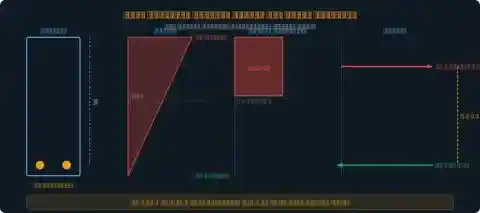
The depth of the equivalent rectangle is related to the neutral axis depth c by the factor β1:
The significance of β1 is often underappreciated by students. As concrete strength increases beyond 28 MPa, the actual stress-strain curve becomes more triangular and less parabolic, so the centroid of the compression force shifts downward. A lower β1 (smaller a for the same c) captures this shift. Engineers using high-strength concrete (HSC, f′c > 55 MPa) must be careful: the β1 = 0.65 minimum means the stress block significantly underestimates the neutral axis depth compared to the actual stress distribution, and additional considerations in ACI 318-19 Appendix B apply.
| f′c (MPa) | f′c (psi) | β1 | Stress Block Depth a for c=200mm |
|---|---|---|---|
| ≤ 28 | ≤ 4000 | 0.850 | 170 mm |
| 30 | 4350 | 0.836 | 167 mm |
| 35 | 5000 | 0.800 | 160 mm |
| 40 | 5800 | 0.764 | 153 mm |
| 50 | 7250 | 0.693 | 139 mm |
| ≥ 56 | ≥ 8000 | 0.650 (min) | 130 mm |
3. Strain Compatibility and the Three Failure Modes
Strain compatibility is the condition that relates the depth of the neutral axis c to the strains throughout the section. With the plane-sections assumption and the ACI 318 ultimate concrete compressive strain of εcu = 0.003, the net tensile strain in the extreme tension steel is:
| Failure Mode | εt Range | φ Factor | Design Acceptability | Behaviour |
|---|---|---|---|---|
| Tension-controlled | εt ≥ 0.005 | 0.90 | ✅ Preferred (ductile) | Steel yields well before concrete crushes. Large deflections & cracking warn of failure. |
| Transition zone | 0.004 ≤ εt < 0.005 | 0.65 to 0.90 (linear interpolation) | ⚠️ Acceptable but penalised | Reduced φ compensates for less ductility. Rarely used for beams. |
| Compression-controlled | εt < 0.004 | 0.65 | ❌ Not permitted for beams | Concrete crushes before steel yields. Brittle, catastrophic failure. ACI prohibits this for flexural members. |
4. Strength Reduction Factors (φ / γ / φ by Code)
Every code applies a strength reduction factor to the nominal capacity to account for variability in material properties, dimensions, and workmanship. The calibration differs between codes, producing different numerical values for what is conceptually the same safety margin:
| Code | Factor Symbol | Tension-Controlled Flexure | Compression-Controlled | Calibration Basis |
|---|---|---|---|---|
| ACI 318-19 (US) | φ | 0.90 | 0.65 | LRFD — applied to resistance side |
| Eurocode 2 (EU) | γc, γs | fcd = fck/1.5; fyd = fyk/1.15 | Same (material partial factors) | Applied to material strengths, not to total resistance |
| AS 3600-2018 | φ | 0.85 (εt ≥ 0.005) | 0.65 | Similar to ACI but slightly lower flexural φ |
| IS 456:2000 | γc, γs | fcd = 0.67 fck/1.5; fyd = fy/1.15 | Same | Limit state method; 0.67 factor accounts for long-term concrete strength |
A critical practical note on ACI vs Eurocode: in ACI the φ factor is applied to the total nominal resistance, while in EC2 separate partial factors (γc = 1.5 for concrete, γs = 1.15 for steel) are applied to each material strength to produce design values fcd and fyd. The resulting moment capacities are similar for typical sections but diverge for high-strength materials where the material partial factor approach gives more refined safety levels.
5. Singly Reinforced Beams — Analysis and Design Procedures
5.1 Analysis: Checking Capacity of an Existing Section
When the cross-section dimensions (b, h) and reinforcement (As) are known, the analysis problem asks: what is φMn? The procedure is:
📋 Step-by-Step Analysis Procedure (ACI 318-19)
- Determine stress block depth: a = As fy / (0.85 f′c b)
- Find neutral axis depth: c = a / β1
- Check net tensile strain: εt = 0.003 (d − c) / c
- Determine φ: If εt ≥ 0.005 then φ = 0.90. If εt < 0.004, section is not permitted.
- Calculate nominal moment: Mn = As fy (d − a/2)
- Apply strength reduction: φMn = φ × Mn
- Check: φMn ≥ Mu (required)
5.2 Design: Finding Required Steel Area for a Given Mu
When Mu is known and the dimensions (b, d) are given or assumed, solving for As requires solving the quadratic formed by the moment equation and the equilibrium condition. The standard ACI design approach uses the dimensionless moment coefficient Rn:
6. Reinforcement Ratio Limits — ρmin and ρmax
The reinforcement ratio ρ = As / (b · d) must satisfy both a minimum and maximum limit. These limits protect against two distinct failure mechanisms: the minimum prevents sudden brittle failure upon first cracking; the maximum ensures the section is not so heavily reinforced that steel cannot yield before concrete crushes.
| Code | ρmin Formula | ρmin (f′c=25 MPa, fy=500 MPa) | ρmax Criterion |
|---|---|---|---|
| ACI 318-19 | max(0.25√f′c/fy, 1.4/fy) | 0.00280 | εt ≥ 0.004 (φMn); εt ≥ 0.005 for φ=0.90 |
| Eurocode 2 | max(0.26 fctm/fyk, 0.0013) | 0.00132 | ξlim per ductility class; x/d ≤ 0.45 (DCM), 0.35 (DCH) |
| AS 3600-2018 | max(0.20 f′cf/fsy, 0.0020) | 0.00200 | εt ≥ 0.004 (Cl. 8.1.5) |
| IS 456:2000 | 0.85/fy | 0.00170 | xu/d ≤ xu,max/d (Table from IS 456) |
7. Doubly Reinforced Beams — When and How
When the required moment Mu exceeds the maximum moment capacity of a singly reinforced section (φMn,max), and section dimensions cannot be increased, compression steel A′s is added near the compression face. The compression steel performs two functions: it increases the moment capacity by creating a second internal force couple, and it improves long-term ductility by restraining creep in the compression zone.
8. T-Beams and Flanged Sections
In monolithic slab-beam construction, the slab acts as a flange of the beam in the compression zone. This dramatically increases the effective compression area, reducing the neutral axis depth and increasing moment capacity compared to an isolated rectangular beam of the same web width.
8.1 Effective Flange Width (ACI 318-19 §6.3.2)
8.2 T-Beam Flexural Analysis — Two Cases
| Case | Condition | Approach | When This Happens |
|---|---|---|---|
| Case 1: NA in Flange | a ≤ hf | Treat as rectangular beam, width = beff. Use standard singly reinforced equations. | Most positive moment T-beam cases at midspan. The large flange area keeps a small, well within hf. |
| Case 2: NA in Web | a > hf | Decompose into flange force Cf and web compression force Cw. Sum moments about steel centroid. | Heavily loaded beams or thin flanges. More common in analysis of existing beams than in typical design. |
For Case 2 (neutral axis in web), the nominal moment is computed as the sum of two sub-moments:
9. Code Comparison — ACI vs Eurocode 2 vs AS 3600 vs IS 456
The four major concrete design codes reach similar results through different philosophical frameworks. Understanding these differences is essential for engineers working across international projects. The table below presents a clause-by-clause comparison of the key flexural design provisions:
| Provision | ACI 318-19 | Eurocode 2 | AS 3600-2018 | IS 456:2000 |
|---|---|---|---|---|
| Concrete strain limit | εcu = 0.003 | εcu2 = 0.0035 (NSC) | εcu = 0.003 | εcu = 0.0035 |
| Stress block shape | Rectangular (Whitney) | Para-rect, bilinear, or rect | Rectangular (γ = 0.85−0.007f′c) | Rectangular (0.36 fck) |
| Stress intensity | 0.85 f′c | η fcd (=0.85 fck/1.5 for NSC) | α2 f′c (= 0.85 for f′c≤65) | 0.36 fck |
| Block depth factor | β1 = 0.85 to 0.65 | λ = 0.8 (NSC), reduces for HSC | γ = 0.85 to 0.67 | 0.42 xu from top |
| φ / safety factor | φ = 0.90 (tension-ctrl) | γc=1.5; γs=1.15 | φ = 0.85 | γc=1.5; γs=1.15 |
| ρmin | 0.25√f′c/fy or 1.4/fy | 0.26 fctm/fyk or 0.0013 | 0.20 f′cf/fsy or 0.002 | 0.85/fy (MPa) |
| Max NA depth | εt≥0.004 (φMn condition) | x/d ≤ 0.45 (DCM), 0.35 (DCH) | εt≥0.004 (Cl. 8.1.5) | xu,max/d tabulated |
| Ductility approach | Strain-based (εt) | x/d ratio + ductility class | Strain-based (εt) | xu/d ratio |
10. Worked Examples — Three Complete Beam Designs

Example 1 — Singly Reinforced Beam: Design for As
📌 Given:
b = 300 mm, h = 550 mm, d = 500 mm (assuming d′′ = 50 mm cover to centroid of steel)
f′c = 28 MPa, fy = 420 MPa
Mu = 250 kN·m (factored moment from structural analysis)
📋 Solution:
Step 1: β1 = 0.85 (f′c = 28 MPa ≤ 28 MPa)
Step 2: Rn = Mu / (φbd²) = 250 × 10&sup6; / (0.90 × 300 × 500²) = 3.704 MPa
Step 3: ρ = (0.85 × 28/420) × [1 − √(1 − 2 × 3.704/(0.85 × 28))]
= 0.05667 × [1 − √(1 − 0.3116)] = 0.05667 × [1 − 0.8285] = 0.00972
Step 4: As,req = 0.00972 × 300 × 500 = 1458 mm²
Step 5 — Check ρmin: max(0.25√28/420, 1.4/420) = max(0.00315, 0.00333) = 0.00333
0.00972 > 0.00333 ✅
Step 6: a = 1458 × 420 / (0.85 × 28 × 300) = 611160/7140 = 85.6 mm
Step 7: c = 85.6 / 0.85 = 100.7 mm
Step 8 — Check εt: εt = 0.003 × (500 − 100.7)/100.7 = 0.003 × 3.964 = 0.01189 > 0.005 ✅ φ = 0.90 confirmed
Step 9: φMn = 0.90 × 1458 × 420 × (500 − 85.6/2) × 10−6 = 0.90 × 1458 × 420 × 457.2 × 10−6 = 251.5 kN·m ≥ 250 kN·m ✅
Select: 3 × N25 bars (As = 1473 mm² > 1458 mm²) ✅
Example 2 — Doubly Reinforced Beam: Design for As and A′s
📌 Given:
b = 300 mm, d = 500 mm, d′ = 65 mm (compression steel centroid)
f′c = 28 MPa, fy = 420 MPa
Mu = 430 kN·m (exceeds singly reinforced capacity)
📋 Solution:
Step 1 — Max singly reinforced moment:
At εt=0.005: cmax = 0.003/(0.003+0.005) × 500 = 187.5 mm; amax = 0.85 × 187.5 = 159.4 mm
ρmax = 0.85 × 0.85 × 28/420 × 0.375 = 0.02138
As,max = 0.02138 × 300 × 500 = 3207 mm²
Mn1 = φ × 3207 × 420 × (500−79.7) × 10−6 = 0.90 × 3207 × 420 × 420.3 × 10−6 = 508 kN·m... wait, recalculate
Mn1 = 0.90 × 3207 × 420 × (500 − 159.4/2) × 10−6 = 0.90 × 3207 × 420 × 420.3 × 10−6 = 509 kN·m
Since 430 kN·m < 509 kN·m, the beam can actually be designed as singly reinforced. This is a deliberate teaching moment: always check before proceeding to doubly reinforced design. Let us instead set Mu = 560 kN·m to illustrate doubly reinforced design (exceeds 509 kN·m).
Step 2 — Excess moment: ΔM = 560 − 509 = 51 kN·m
Step 3 — Check if compression steel yields:
ε′s = 0.003 × (187.5 − 65)/187.5 = 0.003 × 0.653 = 0.00196 < εy = 0.0021
Compression steel does not yield! f′s = 0.00196 × 200,000 = 392 MPa
Step 4: A′s = ΔM / (φ f′s (d − d′)) = 51 × 10&sup6; / (0.90 × 392 × (500−65)) = 51 × 10&sup6; / 153,407 = 332 mm²
Step 5: ΔAs = A′s × f′s/fy = 332 × 392/420 = 309 mm²
Step 6: As,total = 3207 + 309 = 3516 mm²
Select: Tension: 4 × N32 + 2 × N20 = 3217 + 628 = 3845 mm². Compression: 2 × N16 = 402 mm² > 332 mm² ✅
Example 3 — T-Beam Analysis: Find φMn
📌 Given:
Interior T-beam: bw = 350 mm, hf = 120 mm, beff = 1400 mm (calculated from span and spacing), d = 580 mm
As = 4 × N28 = 4 × 616 = 2464 mm²
f′c = 32 MPa, fy = 420 MPa
📋 Solution:
Step 1: β1 = 0.85 − 0.05(32−28)/7 = 0.85 − 0.0286 = 0.8214
Step 2 — Assume NA in flange, use beff:
a = Asfy/(0.85f′cbeff) = 2464 × 420/(0.85 × 32 × 1400) = 1034880/38080 = 27.2 mm
Step 3 — Check assumption: a = 27.2 mm < hf = 120 mm ✅ NA is in flange. Treat as rectangular beam with b = beff.
Step 4: c = a/β1 = 27.2/0.8214 = 33.1 mm
Step 5 — Strain check: εt = 0.003 × (580−33.1)/33.1 = 0.003 × 16.52 = 0.0496 ≫ 0.005 ✅ φ = 0.90
Step 6: φMn = 0.90 × 2464 × 420 × (580 − 27.2/2) × 10−6
= 0.90 × 2464 × 420 × 566.4 × 10−6 = 526 kN·m
Result: φMn = 526 kN·m. The T-flange is so large that only 27 mm of the 120 mm flange is active in compression — typical of floor beam systems at midspan.
11. Interactive Moment Capacity Calculator
Enter your beam dimensions and reinforcement below. The calculator computes a, c, εt, φ, φMn, and ρ checks in real time — no software required.
🔧 Singly Reinforced Beam — φMn Calculator (ACI 318-19, SI)
12. Beam Flexural Design Checklist & Common Errors
✅ Complete Flexural Design Checklist (ACI 318-19)
- ☐ Obtain factored moment Mu from load combination (ASCE 7-22 or local code)
- ☐ Select preliminary beam dimensions (b, h). Rule of thumb: d ≈ span/10 to span/16 for beams
- ☐ Calculate Rn and solve for required ρ
- ☐ Check ρmin ≤ ρreq ≤ ρmax. If ρreq > ρmax: increase dimensions or use doubly reinforced design
- ☐ Calculate As,req = ρ × b × d
- ☐ Select bar arrangement. Check minimum bar spacing (ACI §25.8.1): max(db, 25 mm, 4/3 × max aggregate size)
- ☐ Verify φMn with actual As ≥ Mu
- ☐ Check εt ≥ 0.005 (confirm φ = 0.90 used in design)
- ☐ Design shear reinforcement (ACI Chapter 22) separately — do not omit stirrups
- ☐ Check deflections (ACI §24.2). For d/l < code minimum, compute immediate and long-term deflections
- ☐ Check crack control (ACI §24.3): maximum bar spacing = min(380(280/fs), 300(280/fs))
- ☐ For T-beams: verify effective flange width per ACI §6.3.2 before computing capacity
8 Most Common Flexural Design Errors (From Real Project Reviews)
| # | Error | Consequence | Fix |
|---|---|---|---|
| 1 | Using gross depth h instead of effective depth d | Overestimates moment arm by 10–15%, non-conservative | Always use d = h − cover − stirrup − db/2 |
| 2 | Assuming φ = 0.90 without checking εt | Non-conservative if section is in transition zone | Always compute εt and verify φ |
| 3 | Neglecting ρmin for lightly loaded beams | Brittle fracture at first cracking | Always check As ≥ As,min regardless of Mu |
| 4 | Using wrong β1 for high-strength concrete | Incorrect c and εt, wrong φ selection | Calculate β1 from f′c for every design |
| 5 | Not checking if compression steel yields in doubly reinforced design | Overestimates compression steel contribution | Always compute ε′s and check vs εy |
| 6 | Using bw instead of beff for T-beam design | Extremely conservative — wastes reinforcement | Calculate beff per ACI §6.3.2 for all slab-beam systems |
| 7 | Applying negative moment Mu without flipping the section (tension on top) | Incorrect geometry in analysis equations | For negative moments at supports, d measured from compression face at bottom |
| 8 | Forgetting to check deflections after flexural design | Code-compliant strength but unacceptable serviceability | Run ACI §24.2 deflection check or use minimum h table (ACI Table 9.3.1.1) |
M. Haseeb Mohal, Graduate Structural Engineer
Structural & Civil Engineering Design | RC, Steel & Timber Structures | International Projects
💬 From Practice: The Flexural Check That Almost Went Wrong
Early in practice I reviewed a beam design where the engineer had used h = 600 mm throughout, forgetting that d = h − 50 (cover) − 12 (stirrup) − 16 (bar radius) = 522 mm, not 600 mm. The error resulted in a calculated φMn approximately 15% higher than actual. The beam was already cast. We caught it in peer review. The fix was to add a secondary post-tensioned tendon in the soffit — expensive and complicated. That mistake has never happened again in anything I review. The single most reliable prevention: always write out d = h − [explicit calculation] at the top of every beam design page.
↗ Visit engrhaseeb.com for structural engineering portfolio and international project enquiries
13. FAQ — Answered by a Structural Engineer
🔗 Official Code References & Further Reading
- ACI (concrete.org) — ACI 318-19, commentary, and technical documents
- Eurocodes JRC — EN 1992-1-1 (Eurocode 2) and National Annexes
- Standards Australia — AS 3600-2018 concrete structures standard
- Bureau of Indian Standards — IS 456:2000 plain and reinforced concrete code
- engrhaseeb.com — Structural engineering portfolio and international project enquiries
📚 Related Technical Articles on Civilmat
Conclusion
Flexural design of reinforced concrete beams is simultaneously one of the most routine and most consequential calculations in structural engineering. The equations are elegant precisely because they encode decades of physical testing and probabilistic calibration into four simple steps: compute a, compute c, check εt, calculate φMn. But behind each step lies theory, judgment, and code-specific nuance that separates a robust design from a vulnerable one.
The key principles to carry from this guide: always verify εt — do not assume tension-controlled behaviour; always check ρmin even for light loads; for T-beams, always compute beff before calculating capacity; and for doubly reinforced designs, always verify that compression steel yields before using fy in your calculation of A′s. Master these four checks and you will catch 95% of the errors that appear in beam design reviews.
For further reading on related structural topics, explore the complete guide to structural engineering textbooks and code references or the seismic design guide for beam design in high-seismicity regions where ductility requirements govern over flexural strength.
This article is a technical reference for practising civil and structural engineers. Code clauses cited are from ACI 318-19, EN 1992-1-1, AS 3600-2018, and IS 456:2000. Always consult the applicable code for your project jurisdiction. For structural engineering project enquiries, visit engrhaseeb.com.

Be the first to comment.