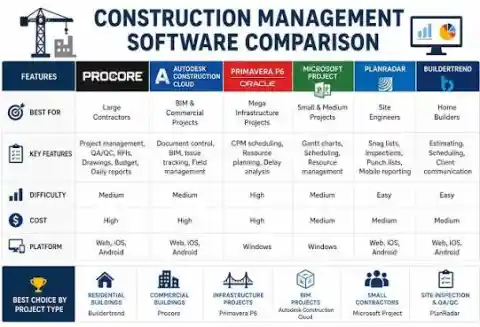
Choosing the wrong project management platform can cost your firm weeks of rework, missed RFIs, and document control nightmares. With BIM 360 (now Autodesk Construction Cloud), Procore, and Oracle Aconex all competing for the construction industry's attention, the differences between them are significant enough to make or break a project's digital delivery strategy. This guide breaks down every major feature category so you can make an informed decision — whether you're a civil engineer, structural consultant, project manager, or BIM manager.
Each platform targets a slightly different segment of the market: BIM 360 excels in design-to-construction BIM workflows, Procore dominates general contractor field operations, and Aconex is the heavyweight for large infrastructure and government projects requiring strict document control audit trails. Read on for the full comparison.
Platform Overviews at a Glance
By: Autodesk
Founded: 2012 (rebranded to Autodesk Construction Cloud 2020)
Best for: Design-to-construction BIM workflows, Revit-centric teams
Market focus: Architects, structural/MEP engineers, BIM managers
Users: 1M+ globally
By: Procore Technologies
Founded: 2003
Best for: General contractor field operations, site management
Market focus: GCs, subcontractors, owners
Users: 2M+ globally
By: Oracle (acquired 2018)
Founded: 2000
Best for: Large-scale infrastructure, government & rail projects
Market focus: Owners, project controllers, document controllers
Users: 70,000+ projects globally
Quick Comparison Table
| Feature Category | BIM 360 / ACC | Procore | Oracle Aconex |
|---|---|---|---|
| Document Control | ⭐⭐⭐⭐ | ⭐⭐⭐⭐ | ⭐⭐⭐⭐⭐ |
| BIM / Model Viewing | ⭐⭐⭐⭐⭐ | ⭐⭐⭐ | ⭐⭐⭐ |
| RFI & Submittal Workflows | ⭐⭐⭐⭐ | ⭐⭐⭐⭐⭐ | ⭐⭐⭐⭐ |
| Field / Site Management | ⭐⭐⭐⭐ | ⭐⭐⭐⭐⭐ | ⭐⭐⭐ |
| Cost Management | ⭐⭐⭐⭐ | ⭐⭐⭐⭐⭐ | ⭐⭐⭐ |
| Scheduling Integration | ⭐⭐⭐ | ⭐⭐⭐⭐ | ⭐⭐⭐⭐ |
| Safety Management | ⭐⭐⭐⭐ | ⭐⭐⭐⭐⭐ | ⭐⭐⭐ |
| Audit Trail / Compliance | ⭐⭐⭐⭐ | ⭐⭐⭐⭐ | ⭐⭐⭐⭐⭐ |
| Mobile App | ⭐⭐⭐⭐ | ⭐⭐⭐⭐⭐ | ⭐⭐⭐ |
| Ease of Use | ⭐⭐⭐⭐ | ⭐⭐⭐⭐⭐ | ⭐⭐⭐ |
| Third-Party Integrations | ⭐⭐⭐⭐⭐ | ⭐⭐⭐⭐⭐ | ⭐⭐⭐ |
| Value for Money | ⭐⭐⭐ | ⭐⭐⭐⭐ | ⭐⭐⭐ |
Document Management
Document control is the backbone of construction project delivery. All three platforms manage drawings, specifications, and correspondence — but their philosophies differ significantly.
| Feature | BIM 360 / ACC | Procore | Oracle Aconex |
|---|---|---|---|
| Drawing version control | ✅ Automatic | ✅ Automatic | ✅ Strict register-based |
| Supersession management | ✅ Yes | ✅ Yes | ✅ Industry-leading |
| Transmittal management | ⚠️ Limited | ✅ Yes | ✅ Best-in-class |
| Document register | ✅ Yes | ✅ Yes | ✅ Full register + audit |
| Custom metadata & attributes | ✅ Yes | ✅ Yes | ✅ Highly configurable |
| Email correspondence tracking | ⚠️ Limited | ⚠️ Limited | ✅ Full mail module |
| Offline access | ✅ Mobile app | ✅ Mobile app | ⚠️ Limited |
RFI & Submittal Workflows
RFIs and submittals are the lifeblood of a construction project. Delays here cascade into programme slippage and cost overruns. Here's how each platform handles them:
| Feature | BIM 360 / ACC | Procore | Oracle Aconex |
|---|---|---|---|
| Automated RFI routing | ✅ Yes | ✅ Yes | ✅ Yes |
| Ball-in-court tracking | ✅ Yes | ✅ Yes | ✅ Yes |
| RFI linking to drawings | ✅ Native | ✅ Yes | ⚠️ Manual |
| Submittal log management | ✅ Yes | ✅ Excellent | ✅ Yes |
| Markup & annotation on RFIs | ✅ Yes (model-linked) | ✅ Yes | ✅ Yes |
| RFI response time tracking | ✅ Yes | ✅ Yes | ✅ Yes |
| Email-to-RFI capture | ⚠️ Partial | ✅ Yes | ✅ Yes (mail module) |
BIM & Model Coordination
This is where BIM 360 / Autodesk Construction Cloud unambiguously leads the market. As an Autodesk product, it integrates natively with Revit, AutoCAD, Civil 3D, Navisworks, and the full AEC software ecosystem.
| Feature | BIM 360 / ACC | Procore | Oracle Aconex |
|---|---|---|---|
| IFC model viewing | ✅ Native viewer | ✅ Via Autodesk integration | ✅ Basic viewer |
| Revit cloud worksharing | ✅ Native (BIM Collaborate) | ❌ No | ❌ No |
| Clash detection | ✅ Native (Model Coordination) | ⚠️ Via integration | ⚠️ Via integration |
| 4D scheduling link | ✅ Yes | ⚠️ Limited | ✅ Yes |
| Model issue tracking | ✅ Linked to model elements | ✅ Drawing-based | ⚠️ Limited |
| Design review in browser | ✅ Full Autodesk Viewer | ✅ Via plugin | ⚠️ Basic |
| Point cloud support | ✅ Yes | ❌ No | ❌ No |
Field Management & Site Inspections
Field management encompasses punch lists, quality inspections, daily reports, and site photos. This is Procore's strongest domain — built from the ground up for boots-on-site use.
| Feature | BIM 360 / ACC | Procore | Oracle Aconex |
|---|---|---|---|
| Punch list / snagging | ✅ Issues module | ✅ Excellent | ⚠️ Basic |
| Quality inspections | ✅ Checklists | ✅ Configurable forms | ⚠️ Limited |
| Daily construction reports | ✅ Yes | ✅ Excellent | ⚠️ Basic |
| Site photos with GPS tagging | ✅ Yes | ✅ Yes | ⚠️ Limited |
| 360° photo integration | ✅ Yes (Autodesk Docs) | ✅ Via Matterport | ❌ No |
| Workforce / manpower tracking | ⚠️ Limited | ✅ Full module | ⚠️ Limited |
| Equipment tracking | ❌ No | ✅ Yes | ❌ No |
Cost Management & Budgeting
Cost overruns are the #1 risk on construction projects. Integrated cost management — where budget impacts from RFIs, change orders, and variations are tracked in real time — can save millions on large projects.
Strong cost module (Budget, Contracts, Change Orders). Integrates with Revit for model-based quantity take-offs. Best for design-phase cost control.
Market-leading cost management — budget tracking, prime contracts, subcontracts, change events, budget forecasting, and ERP integrations (Sage, Viewpoint). Best overall for GCs.
Basic cost tracking. Deep cost management typically requires Oracle Primavera P6 or Unifier alongside Aconex. Not a standalone cost solution.
Scheduling & Program Management
| Feature | BIM 360 / ACC | Procore | Oracle Aconex |
|---|---|---|---|
| Gantt chart / schedule viewer | ⚠️ Basic (via Autodesk Build) | ✅ Yes | ✅ Yes (via P6 integration) |
| Primavera P6 integration | ⚠️ Via connector | ✅ Direct integration | ✅ Native Oracle ecosystem |
| Microsoft Project integration | ✅ Via connector | ✅ Yes | ✅ Yes |
| Look-ahead scheduling | ⚠️ Limited | ✅ Yes | ⚠️ Via P6 |
| 4D BIM (model + schedule) | ✅ Yes (Autodesk) | ⚠️ Limited | ✅ Via Synchro |
Safety Management
Safety incidents carry enormous financial and human costs. A platform's safety module determines how quickly hazards are identified, reported, and corrected on site.
| Feature | BIM 360 / ACC | Procore | Oracle Aconex |
|---|---|---|---|
| Incident reporting | ✅ Yes | ✅ Full module | ⚠️ Basic |
| Safety observations | ✅ Yes | ✅ Yes | ❌ No |
| JSA / SWMS management | ⚠️ Via checklists | ✅ Yes | ❌ No |
| Corrective action tracking | ✅ Yes | ✅ Yes | ⚠️ Limited |
| Safety analytics dashboard | ✅ Yes | ✅ Excellent | ❌ No |
Reporting & Analytics
Data-driven project delivery requires live dashboards — not end-of-month spreadsheet compilations. Here's how each platform handles reporting:
| Feature | BIM 360 / ACC | Procore | Oracle Aconex |
|---|---|---|---|
| Custom dashboards | ✅ Insights module | ✅ Excellent | ✅ Configurable |
| Cross-project analytics | ✅ Yes (portfolio) | ✅ Yes | ✅ Yes |
| Real-time data | ✅ Yes | ✅ Yes | ✅ Yes |
| Export to Excel / PDF | ✅ Yes | ✅ Yes | ✅ Yes |
| Power BI / Tableau connector | ✅ Via API | ✅ Procore Analytics | ✅ Via Oracle BI |
| Predictive analytics | ⚠️ Limited | ✅ Via Procore Analytics | ⚠️ Limited |
Mobile App Comparison
On a construction site, a platform's mobile experience determines whether field teams actually use it or revert to paper and WhatsApp.
✅ iOS & Android
✅ Offline model viewing
✅ Photo capture with mark-up
✅ Issue creation linked to model
⭐⭐⭐⭐ — Very capable, slightly complex UI
✅ iOS & Android
✅ Full offline mode
✅ Daily logs, punch lists, photos
✅ Fastest, most intuitive for site crew
⭐⭐⭐⭐⭐ — Industry gold standard
✅ iOS & Android
⚠️ Limited offline capability
✅ Document viewing
⚠️ Fewer site management features
⭐⭐⭐ — Adequate for document control
Third-Party Integrations
| Integration Category | BIM 360 / ACC | Procore | Oracle Aconex |
|---|---|---|---|
| ERP (Sage, Viewpoint, SAP) | ✅ Via connectors | ✅ 300+ native integrations | ⚠️ Oracle ERP native only |
| Revit / AutoCAD | ✅ Native | ✅ Via Autodesk integration | ⚠️ IFC only |
| Primavera P6 | ✅ Via connector | ✅ Direct integration | ✅ Native Oracle |
| Microsoft 365 | ✅ Yes | ✅ Yes | ✅ Yes |
| Fieldwire / PlanGrid | ✅ (PlanGrid = Autodesk) | ✅ Via marketplace | ❌ No |
| API access | ✅ Full REST API | ✅ Full REST API | ✅ REST API |
| Total marketplace integrations | 250+ | 300+ | ~50 |
Pricing Comparison
All three platforms use custom enterprise pricing based on project volume, number of users, and modules selected. Published list prices are rare, but industry benchmarks give a useful reference:
| Platform | Pricing Model | Approx. Entry Cost | Enterprise Scale |
|---|---|---|---|
| BIM 360 / ACC | Per user/month + project storage tiers | ~$35–$85 USD/user/month | Custom — Autodesk Enterprise contracts |
| Procore | Annual contract by construction volume | ~$375–$700/month (small GC) | $10k–$100k+/year for large firms |
| Oracle Aconex | Per-project or enterprise licencing | ~$1,000–$3,000+/month per project | Custom — Oracle Enterprise Agreement |
Pros & Cons Summary
- Best-in-class BIM coordination and model viewing
- Native Revit cloud worksharing
- Autodesk ecosystem lock-in = seamless for Autodesk shops
- Strong design-to-construction data continuity
- Powerful Insights analytics module
- Expensive at enterprise scale
- Less polished for pure site/field management vs Procore
- Complex module structure (many separate products)
- Requires Autodesk expertise to configure fully
- Most user-friendly interface in the market
- Exceptional field management and mobile experience
- Widest integration marketplace (300+ tools)
- Volume-based pricing (good for large teams)
- Best-in-class cost management module
- BIM coordination is not native — requires Autodesk plugin
- Can be expensive for small subcontractors
- Some advanced modules require add-on costs
- Document control lacks Aconex's audit depth
- Unmatched document register and transmittal audit trail
- Designed for multi-party, multi-contractor projects
- Native Oracle Primavera P6 integration
- Proven on $10B+ infrastructure megaprojects
- Strong in APAC, Middle East, and Europe government
- Outdated UI — steep learning curve
- Weak mobile app compared to competitors
- Poor native BIM coordination capabilities
- High per-project cost for smaller projects
- Limited integration marketplace outside Oracle ecosystem
Which Platform Should You Choose?
| Your Project Type | Recommended Platform | Reason |
|---|---|---|
| Multi-discipline BIM project (Revit-heavy) | 🥇 BIM 360 / ACC | Native Revit integration, model coordination, clash detection |
| General contractor managing subcontractors | 🥇 Procore | Best field management, cost tracking, and subcontractor portals |
| Large infrastructure / rail / government | 🥇 Oracle Aconex | Contractual document control, transmittal audit, P6 native |
| Design consultant (structural/civil/MEP firm) | 🥇 BIM 360 / ACC | Revit cloud sharing, design review, issue tracking |
| Mixed-use commercial development | 🥇 Procore | Best overall feature breadth for owner-GC-sub workflows |
| Public sector / owner's representative | 🥇 Oracle Aconex | Full audit trail, multi-party access, compliance-ready |
| Small to mid-size contractor | 🥇 Procore | Easiest to adopt, mobile-first, strong support |
Frequently Asked Questions
Is BIM 360 the same as Autodesk Construction Cloud?
BIM 360 is the predecessor product that Autodesk rebranded and consolidated into Autodesk Construction Cloud (ACC) from 2020 onwards. ACC includes all BIM 360 capabilities plus additional products like Autodesk Build, Autodesk Docs, and Autodesk Takeoff. Existing BIM 360 customers were migrated to ACC. The term "BIM 360" is still widely used informally to refer to the Autodesk project management platform.
Can Procore view Revit models?
Yes — Procore integrates with Autodesk's BIM 360/ACC platform to enable Revit model viewing inside Procore. The integration syncs RFIs, submittals, and issues between both platforms. However, Procore does not support native Revit cloud worksharing — that requires BIM 360 / Autodesk Construction Cloud directly.
Is Oracle Aconex suitable for small projects?
Generally no. Oracle Aconex is architecturally designed for complex, multi-party projects with strict document control requirements — typically projects over $50M AUD / $30M USD in value. Its per-project cost structure and steep learning curve make it impractical and uneconomical for smaller builds. Procore or even simpler tools like Fieldwire or Procore entry tiers are better suited for smaller projects.
Which platform is best for structural engineering consultants?
For structural engineering consultants whose work is Revit-based, Autodesk Construction Cloud (BIM 360) is the natural choice — particularly for Revit cloud worksharing, model-based issue tracking, and coordinating with architectural and MEP teams. If the consultant is mostly managing documents and correspondence on large infrastructure projects, Oracle Aconex may be required by the project owner. Procore is more relevant if the firm is managing construction directly rather than purely providing design services.
Do all three platforms support Primavera P6 scheduling?
Yes, all three integrate with Primavera P6, but at different levels. Oracle Aconex has the most native integration (both are Oracle products). Procore offers a direct, well-documented P6 integration. BIM 360 / ACC supports P6 via a third-party connector. For programme-critical infrastructure projects, the Aconex + P6 combination is the most seamless.
What is the best alternative to all three platforms?
Other notable alternatives include: PlanGrid (now part of Autodesk), Fieldwire (excellent for small GCs and field teams), Bentley ProjectWise (engineering document management, especially for infrastructure), Trimble ProjectSight, and Newforma (popular with architecture and engineering firms). For civil infrastructure specifically, Bentley ProjectWise is a strong Aconex alternative with deep CAD and OpenRoads integration.
Conclusion
There is no single "best" platform — the right choice depends on your project type, team size, and the phase of delivery you're managing. As a rule of thumb: choose BIM 360 / Autodesk Construction Cloud if BIM coordination and design management are your priority; choose Procore if you're a general contractor needing the best field management, cost control, and ease of adoption; and choose Oracle Aconex if you're delivering a large infrastructure or government project requiring rock-solid document audit trails and P6 programme integration.
The most sophisticated project delivery teams in the world often use two of these platforms together — leveraging each one's strengths across the design and construction phases. Whichever platform you choose, the critical success factor is consistent adoption by all project parties — a perfect platform used by only half the team delivers worse outcomes than an average platform used by everyone. Request trials from all three vendors, test them against your actual project workflows, and negotiate hard on pricing before committing.
Be the first to comment.