Foundation repair costs between $2,000 and $25,000 for most residential structures in the United States, with a national average near $4,500. The method — not the visible crack — determines the price. Epoxy injection runs $250–$500 per crack. A full steel pier underpinning system runs $1,000–$1,500 per pier, and most settling homes need 8 to 15 of them. Before signing anything, know where your project falls in that range.
Getting three quotes for identical foundation damage often produces numbers ranging from $4,500 to $18,000. That's not negotiating room — that's contractors with different equipment, preferred methods, and margin expectations. This guide breaks down every major repair method with real cost data, explains which soil conditions demand which fix, and gives you an interactive calculator to stress-test any quote you receive.
Cost data below draws from Foundation Repair Association (FRA) surveys, HomeAdvisor and Angi 2022–2023 aggregated contractor pricing, ASCE 7 load criteria, and structural engineering practice across the US, Canada, and UK. Clay-dominant sites — Texas, Oklahoma, Mid-Atlantic states — consistently run 15–30% higher than quotes on sandy or gravelly soil, and that's baked into the regional breakdowns.
Why Foundations Fail: The Structural Mechanism
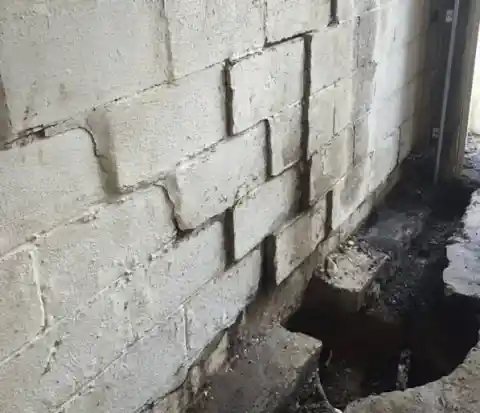
Visible cracks don't tell you much by themselves. A 3mm hairline crack in a basement wall could be cosmetic settlement from the first few years after construction — or it could be the leading edge of lateral wall bowing driven by 4,000 psf of hydrostatic soil pressure. The mechanism matters more than the appearance, and that mechanism is always soil-related.
Four failure modes account for roughly 95% of residential foundation repair work:
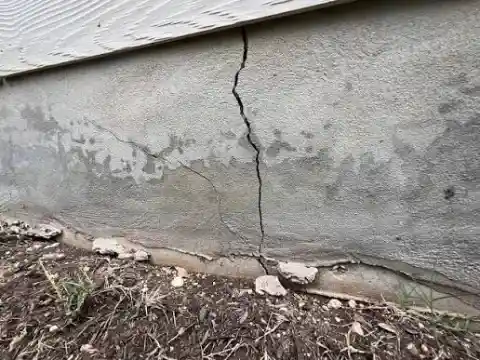
- Differential settlement — uneven soil compression under structural load. Most common in soils with plasticity index (PI) above 20. One corner of the footing drops 1–3 inches while the opposing corner stays level. Result: 45° diagonal cracks radiating from door and window corners.
- Lateral wall movement — hydrostatic pressure from saturated backfill pushes basement or retaining walls inward. Walls bow 1–3 inches at mid-height. The 2-inch deflection mark is the critical engineering threshold — past that point, most structural engineers stop recommending carbon fiber or anchoring and start recommending partial or full wall replacement.
- Shrink-swell cycling — expansive soils (Vertisols common in Texas, Oklahoma, parts of California, and the Mid-Atlantic) change volume dramatically as moisture content changes. A soil with PI of 35–50 can generate swell pressures of 5,000–20,000 psf — far exceeding the design load of standard residential footings.
- Undermining and void formation — erosion from plumbing leaks, stormwater channeling, or compaction failures creates voids below footing bearing areas. The footing loses contact with the soil and begins to cantilever across the void. Often invisible from the surface until the void is large enough to cause sudden settlement.
Soil bearing capacity is the core design parameter. A standard residential spread footing is designed for 1,500–2,000 psf on well-compacted native soil. When that capacity drops — through saturation, organic decomposition, or disturbance — the structure above it reacts. The crack you see in the wall is the structure's way of redistributing load it can no longer transfer cleanly to the ground.
Foundation Repair Cost Estimate by Method
The table below covers every mainstream residential repair method. These are contractor-installed costs, not material-only figures. Permit fees ($200–$800 depending on jurisdiction) and engineering reports ($500–$2,000) are separate line items in most states.
| Repair Method | Per-Unit Cost | Typical Project Range | Best For | Avg. Duration | ||||
|---|---|---|---|---|---|---|---|---|
| Epoxy Crack Injection | $250–$500/crack | $500–$2 | 500 | Stable structural or non-structural cracks (≤3mm) | 2–4 hrs | |||
| Polyurethane Injection | $300–$600/crack | $600–$3 | 000 | Active water-leaking cracks; flexible seal needed | 2–4 hrs | |||
| Mudjacking (Slabjacking) | $3–$8/sq ft | $600–$1 | 500 | Settled concrete slabs; driveways; walkways | 4–8 hrs | |||
| Polyjacking (Foam Leveling) | $5–$25/sq ft | $500–$1 | 200 | Smaller voids; faster cure; lightweight | 2–4 hrs | |||
| Steel Push Piers | $1 | 000–$1 | 500/pier | $8 | 000–$22 | 500 | Foundation settlement where stable strata exist below | 1–2 days |
| Helical Piers | $1 | 500–$2 | 500/pier | $9 | 000–$30 | 000 | Poor near-surface soil; tension applications; new construction | 1–3 days |
| Carbon Fiber Straps | $400–$600/strap | $3 | 200–$7 | 200 | Bowing basement walls with deflection under 2 inches | 1–2 days | ||
| Wall Plate Anchors | $1 | 500–$3 | 500/anchor | $6 | 000–$14 | 000 | Bowing walls where soil excavation is feasible | 2–4 days |
| Crawl Space Encapsulation | $5 | 000–$15 | 000/job | Same | Moisture damage; wood rot; vapor intrusion | 2–5 days | ||
| Interior Waterproofing | $3 | 000–$10 | 000/job | Same | Water seepage through walls/floor; sump pump addition | 2–4 days | ||
| Exterior Waterproofing | $8 | 000–$25 | 000/job | Same | Complete moisture barrier; requires full perimeter excavation | 3–7 days | ||
| Full Foundation Replacement | $20 | 000–$100 | 000+/job | Same | Unrepairable structural failure or original construction defect | 2–6 weeks |
Epoxy & Polyurethane Crack Injection ($250–$600 per crack)
Epoxy injection (compliant with ASTM C881) achieves compressive strength of 10,000–14,000 psi when fully cured — stronger than most concrete mixes. Polyurethane foam is used for cracks with active water infiltration because it remains flexible and seals wet surfaces that epoxy won't bond to. The two are not interchangeable: choosing polyurethane for a dry structural crack wastes money on flexibility you don't need.
Critical caveat: injection only holds when the underlying cause has been addressed. Injecting cracks in a foundation that's still settling is like patching a tire that's still on a nail. The repaired crack will re-open within 12–18 months. A soil investigation before injection work is money well spent.
Mudjacking and Polyjacking ($500–$1,500 per job)
Mudjacking pumps a cementitious slurry under a settled slab through drilled holes (1.5–2 inch diameter), filling voids and hydraulically raising the slab. Polyjacking uses expanding polyurethane foam through smaller holes (5/8 inch) and cures in 15 minutes vs. 24+ hours for mudjacking slurry. Polyjacking material weighs about 4 lbs/cubic foot versus 100+ lbs for mudjack slurry — a significant difference if the underlying soil has limited bearing capacity.
Neither method is permanent if the void-forming mechanism remains active. A plumbing leak or erosion channel that created the original void will create another one. Fix the source before lifting the slab.
Steel Push Pier Underpinning ($8,000–$22,500 typical project)
Steel push piers (resistance piers) use the existing building weight as reaction force during installation. Pier segments are driven hydraulically through weak near-surface soil until reaching competent load-bearing strata or bedrock. Once all piers are installed, hydraulic jacks lift the foundation simultaneously toward its original elevation.
Per-pier cost runs $1,000–$1,500 installed. A typical residence requires 8–15 piers depending on foundation perimeter, load distribution, and soil conditions. Ask contractors to specify both the target driving force (typically 1.5× the design load) and expected pier depth — both should appear in the written scope. Piers driven only to a preset depth without verifiable capacity data should not be accepted.
Steel push piers cannot be used where the near-surface soil is too loose to provide adequate reaction — you need sufficient building weight above. Structures under about 700 lbs per linear foot of perimeter may not qualify.
Helical Pier Installation ($9,000–$30,000 typical project)
Helical piers are screwed into the ground using a hydraulic torque motor, independent of building weight as reaction force. This makes them the only viable pier option for new construction, lightly loaded structures, and applications requiring tension capacity. The torque-to-capacity relationship allows real-time load verification during installation — the installation torque is measured and converted to bearing capacity using an empirical factor (Kt). Every pier is effectively load-tested as it's installed.
Per-pier cost is $1,500–$2,500, with typical projects using 6–12 piers. The higher unit cost versus steel push piers is often justified by the capacity verification and their superior performance in tension (uplift) loading — relevant in expansive soil zones where seasonal heave can lift a foundation as much as settlement lowers it.
Carbon Fiber Reinforcement ($3,200–$7,200 typical project)
Carbon fiber composite straps bond to a bowing concrete or block wall using high-strength structural epoxy. They arrest further inward movement — but do not reverse existing deflection. This is not a marketing limitation; it's structural mechanics. The strap adds tensile resistance to a wall that's being pushed in flexure. It can't undo the flexural deformation that's already occurred without an external force applied in the opposite direction.
Installation cost runs $400–$600 per strap, with 8–12 straps at 4-foot spacing being the typical residential application. Appropriate only when wall deflection is less than 2 inches. The repair is minimally invasive (no excavation) but carries a disclosure requirement in most US states — a structural repair has been performed, which affects property value assessments and real estate transactions.
Wall Plate Anchors ($6,000–$14,000 typical project)
Plate anchors pair an interior steel plate to an exterior anchor buried 8–10 feet into surrounding soil, connected by a threaded steel rod through the wall. Unlike carbon fiber, plate anchors can gradually straighten a bowing wall by tightening the rods periodically (once or twice per year). The process takes 2–5 years to produce measurable straightening. The drawback: exterior anchor installation requires open yard space and disrupts landscaping in a 10-foot radius around the anchor point.
Waterproofing Systems ($3,000–$25,000)
Interior waterproofing (French drains, sump pumps, drainage channels at the footing) manages water after it enters the structure. Exterior waterproofing (excavation, membrane coating, drainage board, perimeter tile drain at footing level) prevents entry. Interior systems cost $3,000–$10,000. Exterior systems cost $8,000–$25,000 due to excavation, waterproof membrane materials, and backfill restoration.
Interior systems are appropriate maintenance, not repair. If you're dealing with structural water damage — bowing walls, corroding rebar, deteriorating concrete — exterior systems are the engineering answer. Interior systems are a drainage management tool for manageable seepage in structurally sound basements.
Full Foundation Replacement ($20,000–$100,000+)
Full replacement is the endpoint — every other method failed, was inappropriate, or the foundation was built incorrectly to begin with. The structure is lifted using temporary shoring, the existing foundation is demolished and removed, new footings and stem walls are formed and poured, and the structure is lowered back onto the new foundation. It's rarely cost-justified for structures worth less than $150,000.
Interactive Foundation Repair Cost Estimator
This calculator uses per-unit contractor rates and regional adjustment factors to generate a preliminary cost range. It doesn't replace a site-specific assessment — but it gives you a defensible baseline before talking to contractors. If your quote falls significantly above the upper bound, ask the contractor to justify the delta in writing.
Foundation Repair Cost Calculator
Adjust inputs below. Regional factors are based on aggregated contractor data from HomeAdvisor, Angi, and the Foundation Repair Association (2022–2023). Severity multipliers reflect access difficulty, soil complexity, and structural involvement.
Set to 1 for whole-job methods: mudjacking, waterproofing, crawl space, replacement.
Foundation Repair Cost by Foundation Type
Foundation type affects both method selection and access costs. Pier-and-beam foundations are often cheapest to repair because the crawl space provides direct access without excavation. Slab-on-grade requires saw-cutting and is the most disruptive to interior finishes. Basement foundations carry the highest waterproofing costs due to total wall surface area and depth.
| Foundation Type | Common Failure Modes | Primary Repair Method | Cost Range (USD) | Key Notes | ||
|---|---|---|---|---|---|---|
| Slab-on-Grade | Settlement; cracking; heave from expansive soil | Mudjacking / Polyjacking / Steel Piers | $1 | 500–$25 | 000 | "Most common in South/Southwest US. Expansive clay adds 15–30% to quotes." |
| Basement (Poured Concrete) | Lateral bowing; water intrusion; differential settlement | Carbon Fiber / Wall Anchors / Waterproofing | $4 | 000–$30 | 000 | "Deflection > 2 inches triggers wall replacement recommendation. Common in Midwest/Northeast." |
| Basement (Block / CMU) | Cracking; step-joint failure; bowing | Wall Anchors / Grouting / Full Repair | $5 | 000–$35 | 000 | "Block walls have lower flexural capacity than poured concrete. Step cracking is characteristic." |
| Crawl Space | Beam sag; wood rot; pier settlement; moisture damage | Encapsulation / Joist Sistering / Shim | $3 | 000–$20 | 000 | "Wood rot risk increases 60% if crawl space humidity exceeds 70% sustained. Southeast US most affected." |
| Pier and Beam | Beam deflection; pier settlement; sill plate deterioration | Pier Replacement / Shim / Epoxy Repair | $1 | 000–$8 | 000 | "Often DIY-accessible via crawl space. Most economical repair in ideal access conditions." |
Regional Foundation Repair Cost Variation
Labor rates, material supply chain proximity, contractor market density, and soil complexity all shift the baseline significantly. Texas contractors price competitively because foundation repair is almost an endemic industry there — expansive clay affects an estimated 40% of residential properties in the state. California quotes run 45% above the national average due to labor regulations, CEG requirements, and permit complexity.
| Region | Moderate Repair Range | Regional Factor | Dominant Soil | Key Cost Driver | ||||
|---|---|---|---|---|---|---|---|---|
| Texas / Oklahoma | $3 | 200–$12 | 000 | 0.85× | "Expansive Vertisol clay (PI 30–50)" | "High contractor competition; established supply chains" | ||
| US South (non-TX) | $3 | 800–$14 | 000 | 0.90× | Variable clay/sand mix | Moderate labor rates; lower permitting overhead | ||
| US Midwest | $4 | 500–$18 | 000 | 1.05× | Clay / silt loam | Freeze-thaw cycles require deeper pier installation | ||
| US Northeast | $5 | 500–$22 | 000 | 1.25× | Glacial till / bedrock | "Prevailing wage; deep frost line (3–4 ft); urban access" | ||
| US West Coast | $6 | 000–$24 | 000 | 1.30× | Expansive clay / alluvium | Seismic zone requirements add engineering costs | ||
| California | $7 | 000–$30 | 000 | 1.45× | Adobe / expansive clay | "CEG requirements; permitting burden; high contractor demand" | ||
| Canada (major cities) | $5 | 200–$20 | 000 CAD | 1.15× | Prairie clay / urban fill | Frost depth requirements; longer cure times in cold climate | ||
| United Kingdom | £3 | 500–£18 | 000 (~$4 | 400–$22 | 500 USD) | 1.40× | London Clay / mixed fill | "Structural survey requirements; conservation area restrictions" |
What Drives Your Foundation Repair Quote Up or Down
Most homeowners focus on visible damage when comparing quotes. Contractors focus on something different: how hard is this job to execute? These two perspectives produce the largest gap in quote justification.
- Number of piers or straps required — this is the single largest cost variable in underpinning and wall repair. The perimeter of the foundation, load distribution, and soil conditions all determine unit count. A contractor who specifies 8 piers at $1,200 each and another who specifies 15 piers at $950 each can produce the same total price for very different scopes of work. Ask both what drives their pier count.
- Pier depth to competent strata — shallow refusal means cheaper installation. Dense limestone at 12 feet costs less to reach than soft clay that requires 30+ feet of pier segments. In Dallas, you might hit refusal at 10 feet. In Houston's soft clay, 25–40 feet is common. Depth isn't always disclosed upfront.
- Interior vs. exterior access — exterior wall repair requiring full excavation (exterior waterproofing, wall plate anchors) costs 3–5× more than interior-access methods. Landscaping removal, shoring of adjacent structures, utility clearances, and backfill all contribute.
- Soil type — expansive clay increases mobilization time, hampers equipment positioning, and sometimes requires pre-installation dewatering. Contractors in clay-heavy markets price accordingly.
- Permit and engineering requirements — some jurisdictions require a licensed structural engineer to design the repair, stamp the drawings, and inspect the work. This adds $500–$2,000 in engineering fees and 2–4 weeks to the project timeline. Ask whether permits are included in the quote.
- Warranty terms — a 25-year transferable warranty costs the contractor something in deferred liability. Short warranties (5 years, non-transferable) often signal lower-quality materials or shallower pier depths. Compare warranty terms alongside price.
- Mobilization fees — equipment transport and setup is often charged separately ($500–$2,000). Some contractors hide it in per-unit rates; others list it. Ask directly.
Structural Engineering: Pier Capacity Formulas
For engineers and technically-minded homeowners reviewing a repair specification, these are the two primary capacity calculations used in foundation pier design. Understanding them helps you evaluate whether a contractor's pier count and depth are structurally defensible.
Terzaghi's General Bearing Capacity Equation
Used to verify that the strata where piers reach refusal can actually support the transferred load:
c = Soil cohesion (psf) — zero for purely granular soils
q = Effective overburden pressure = γ × Df
γ = Unit weight of soil (pcf; typically 110–135 pcf)
B = Footing width (ft)
Df = Depth of foundation below grade (ft)
Nc, Nq, Nγ = Bearing capacity factors (functions of friction angle φ)
Example values for φ = 30°: Nc = 30.1, Nq = 18.4, Nγ = 15.7
Helical Pier Torque-to-Capacity Correlation
The ICC AC358 standard uses this relationship to verify capacity during installation. The installation torque is a real-time proxy for soil resistance:
Kt = Empirical capacity-to-torque ratio (typically 6–10 ft−1 for standard helix plates)
T = Average installation torque over last 3 ft of penetration (ft·lbs)
Example: T = 6,000 ft·lbs, Kt = 7 ft−1 → Qult = 42,000 lbs = 21 tons per pier
Apply a safety factor of 2.0–2.5 for design: Qallow = Qult / FS
Request the torque log from your contractor after helical pier installation. Each pier should show torque readings at regular depth intervals. Piers that reached target depth without reaching target torque did not achieve design capacity — a fact worth understanding before the concrete cap is poured.
What Homeowners Actually Say About Foundation Repair Costs
Beyond contractor brochures and manufacturer specs, there's a body of candid, vote-weighted community experience worth reading. Here's what r/homeowners, r/DIY, and r/RealEstate threads consistently surface about foundation repair cost realities:
Free Downloads & Reference Resources
The resources below are publicly available from standards bodies, government agencies, and professional organizations. They're the same documents engineers reference during foundation assessments.
| Resource | Publisher | Type | Relevance | Access |
|---|---|---|---|---|
| Foundation Repair Standards (FRS-2022) | Foundation Repair Association | PDF Standard | Defines acceptable repair methods and warranty requirements | Free at foundationrepairassociation.org |
| ASCE/SEI 7-22 Ch. 12 (Seismic Design) | ASCE | Standard Reference | Governs foundation design in seismic zones; relevant for West Coast repairs | Purchase at asce.org |
| ICC AC358: Acceptance Criteria for Helical Pile Systems | ICC | Technical Report | Defines torque-capacity correlation and installation verification | Free at icc-es.org |
| Expansive Soils (USGS Fact Sheet 2001-049) | USGS | Identifies US expansive soil zones; helps assess if your site is at risk | Free at pubs.usgs.gov | |
| Moisture Control Guidance (EPA 402-K-11-004) | EPA | PDF Guide | Crawl space and basement moisture management best practices | Free at epa.gov/iaq |
| ACI 224R-01: Control of Cracking in Concrete Structures | ACI | Technical Report | Crack width limits and classification for concrete members | Free preview at concrete.org |
| ASTM C881: Epoxy-Resin Adhesive for Concrete | ASTM | Material Standard | Governs epoxy injection material quality | Purchase at astm.org |
| HUD Guidebook: Residential Structural Problems | HUD / HUD-PDR | Homeowner-accessible guide to recognizing and responding to foundation issues | Free at huduser.gov |
Need an Independent Structural Assessment?
Getting an independent structural engineer's opinion before committing to a major foundation repair is often the most cost-effective step you can take. An engineer's report ($500–$2,000) can confirm the repair method, verify the pier count, and give you leverage to negotiate contractor quotes. M. Haseeb Mohal is a structural engineer available for remote consultation on foundation assessment reports, design review, and repair specification review for international residential and commercial projects.
Frequently Asked Questions
How to Get an Accurate Foundation Repair Estimate
- 1Document the damage before calling anyonePhotograph every crack, measure its width at the widest point, mark crack ends with pencil and date (to monitor growth), and note any associated symptoms: sticking doors, uneven floors, water intrusion. This documentation is your baseline and will help you compare what different contractors are actually proposing to fix.
- 2Order an independent geotechnical or structural engineer assessmentBefore calling foundation repair contractors, spend $500–$2,000 on an independent licensed structural engineer (SE) or professional engineer (PE) assessment. The engineer will identify the failure mechanism, specify the appropriate repair method, and provide a written report. This report is your negotiating document with contractors and satisfies most permit requirements.
- 3Obtain at least three itemized quotes from licensed contractorsContact three contractors minimum. Require itemized quotes showing: unit count and unit price, material specifications (pier grade, strap width/thickness, epoxy ASTM reference), mobilization fees, permit inclusion or exclusion, engineering stamp inclusion or exclusion, and warranty terms in writing. Reject any quote that's a single lump sum without unit breakdown.
- 4Verify contractor credentialsConfirm: valid state contractor license (check your state licensing board), general liability insurance (minimum $1M per occurrence), workers' compensation coverage, and membership in the Foundation Repair Association (FRA) or equivalent. Request references from jobs completed within 12 months in your soil type and geography.
- 5Cross-reference quotes against your engineering reportYour engineer specified a repair method and approximate scope. Compare each contractor quote against that specification. Quotes proposing significantly fewer piers, shallower depths, or different methods than the engineer specified should be flagged and the contractor asked to justify the deviation in writing before you proceed.
- 6Review warranty terms carefullyA 25-year transferable warranty is the industry benchmark. Confirm: what triggers the warranty (settlement beyond X inches?), what the contractor's response obligation is, whether the warranty transfers to new owners on sale, and whether it's backed by a third-party insurer. Contractor-only warranties from small firms carry financial risk if the company dissolves.
Related Articles on CivilMat
- Retaining Wall Design per ACI 318: Step-by-Step
- Geotechnical Engineering Consulting Fees: A Complete Cost Guide
Bottom Line
Foundation repair is one of the highest-variance home repair categories — the same crack on the same foundation can generate quotes ranging from $4,000 to $20,000 depending on who's looking at it and what equipment they own. The contractors who specialize in piers quote pier solutions. The contractors who specialize in carbon fiber quote carbon fiber. That's not dishonesty; it's expertise bias. The only way to cut through it is an independent engineer's assessment before you talk to anyone who's also selling the repair.
The two most consistent money-saving moves: get at least three itemized quotes (not lump sums), and hire an independent structural engineer to define the scope before contractors do it for you. The $800–$1,500 engineering fee saves $3,000–$8,000 on average by eliminating both under-engineering (repairs that fail) and over-engineering (unnecessary scope).
For reference standards and further reading, the Foundation Repair Association, ASCE, and ICC Evaluation Service publish the technical standards that govern this work. If a contractor can't reference any of them, that tells you something.

Be the first to comment.